
How to Sleep Better with CBD: A Practical Guide
TL;DR:
- CBD may promote natural sleep by reducing anxiety and pain and acting on the endocannabinoid system.
- It is important to choose the right form, use the appropriate dosage, and combine CBD with rigorous sleep hygiene for lasting results.
You have been tossing and turning in bed for hours, your mind racing and your body tense. Millions of Europeans experience this scenario every night, and many are looking for an alternative to conventional sleeping pills. In this context, the question of how to sleep better with CBD is becoming increasingly relevant. Cannabidiol is attracting genuine interest, supported by positive testimonials and some promising scientific data. This guide explains how it works, which forms to choose, how to determine the dosage, and, above all, how to incorporate it intelligently into your daily routine.
Table of contents
- Key points
- How to sleep better with CBD: the mechanism
- Choosing the right CBD format
- Dosing and incorporating CBD into your routine
- CBD and overall sleep hygiene
- Limitations, risks, and precautions to know
- My opinion on CBD as a sleep aid
- Reliable CBD products for better sleep in Europe
- FAQ
Key points
| Point | Details |
|---|---|
| CBD works indirectly | It reduces anxiety and pain to promote natural sleep, rather than acting like a sleeping pill. |
| Choosing the right form | Sublingual oil for falling asleep quickly, gummies or capsules to maintain sleep throughout the night. |
| Patience and consistency | Clear effects appear after 10 to 14 days of daily, regular use. |
| An essential healthy lifestyle | CBD alone is not enough. It works best alongside a solid, consistent sleep routine. |
| Consult a doctor | If you are taking medication or experiencing chronic insomnia, medical advice remains essential. |
How to sleep better with CBD: the mechanism
To understand why CBD may improve sleep, you must first understand why sleep goes off track. The sleep–wake cycle is regulated by an internal biological clock that is sensitive to light, temperature, and stress. When anxiety rises or chronic pain sets in, this cycle becomes disrupted. This is where CBD comes in—not by knocking out the brain, but by addressing the underlying causes.
CBD interacts with the endocannabinoid system, a network of receptors found throughout the body that helps regulate mood, pain, and sleep. It also influences serotonin receptors, which explains its documented anxiolytic effect. CBD reduces anxiety and pain, thereby indirectly promoting better-quality sleep, with 60 to 70% improvement reported among regular users.
“CBD does not replace a conventional sleeping pill: it works by reducing underlying causes such as anxiety or pain and promotes sleep continuity and recovery.”
However, we must be honest about the current scientific limitations. Research is still limited, with few large-scale randomized clinical trials. Positive results often come from studies on anxiety or pain, not directly on sleep. This does not disqualify CBD, but it calls for a measured and personalized approach.
The reasonably expected benefits of CBD for sleep include:
- Less time needed to fall asleep thanks to reduced mental restlessness
- Fewer nighttime awakenings with regular use
- A clearer sense of recovery in the morning
- A more stable mood, making subsequent nights easier
Choosing the right CBD format
Not all CBD products are equally suitable for sleep, and the format matters just as much as the concentration. Each form has a different onset time and duration of effects, which determines when during the night it will be most useful.
| Form | Onset of action | Duration of effects | Recommended use |
|---|---|---|---|
| Sublingual oil | 15 to 45 minutes | 4 to 6 hours | Difficulty falling asleep |
| Vaping | 5 to 15 minutes | 2 to 3 hours | Falling asleep quickly |
| Gummies / candies | 45 to 90 minutes | 6 to 8 hours | Frequent nighttime awakenings |
| Capsules | 45 to 90 minutes | 6 to 8 hours | Regular use, precise dosing |
| CBD infusions | 30 to 60 minutes | 3 to 5 hours | Relaxation ritual before bed |
Sublingual oil remains the most versatile form for sleep. It is absorbed quickly under the tongue after being held there for 1 to 2 minutes, allowing for precise dosing and a relatively predictable onset of effects.
For people who wake up in the middle of the night or experience fragmented sleep, extended-release formats such as gummies or capsules are often more suitable. Their effect lasts longer, even though the onset of action takes longer.
Another often-overlooked point is the product’s spectrum. Full-spectrum oils contain other hemp compounds such as CBN, terpenes, and minimal traces of legal THC, which enhance the effect of CBD through what is known as the entourage effect. A full-spectrum or broad-spectrum product will generally produce better results than a pure isolate.
To select a quality product, here are the criteria to check:
- Certificates of analysis (COAs) issued by an independent third-party laboratory
- THC level below 0.3% (European standard)
- Traceable hemp origin, preferably European
- No residual solvents or contaminants in the analysis
Dosing and incorporating CBD into your routine
Dosage is one of the topics that causes the most confusion. There is no universal dose because the response to CBD depends on weight, metabolism, individual sensitivity, and the cause of sleep problems. What works for your neighbor may not necessarily work for you.
Here is a gradual approach you can follow:
- Start low. An initial dosage of 10 to 15 mg per day is recommended. This is enough to observe a response without risking adverse effects.
- Monitor for 10 to 14 days. Don’t change the dose too quickly. Clear effects appear after 10 to 14 days of regular use. Note your sleep quality every morning.
- Adjust gradually. If the effect is insufficient after two weeks, increase by 5 mg in 7-day increments. Most users find their optimal dose between 15 and 40 mg.
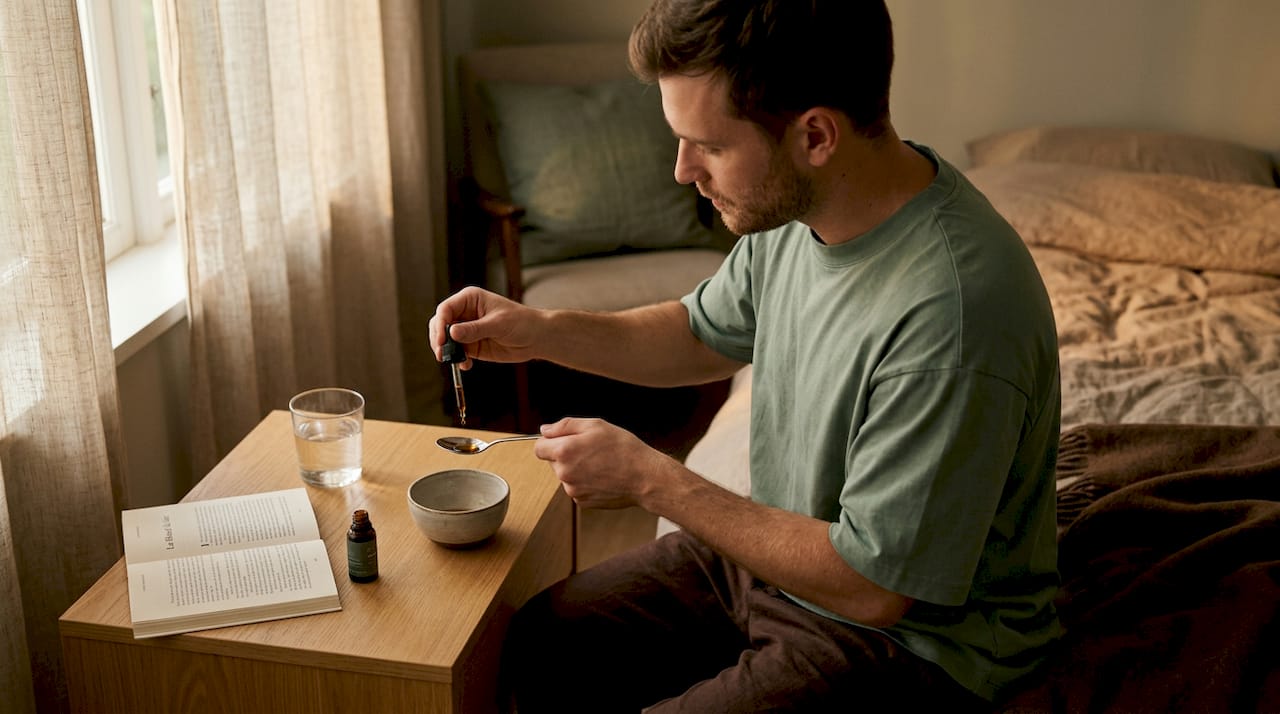
- Choose the right time. For sublingual oil, take it 30 to 45 minutes before bed. For gummies, allow 60 to 90 minutes.
- Stay consistent. Taking CBD irregularly produces inconsistent results. Consistency is the key to effectiveness.
Pro tip: Combine your CBD intake with a room temperature of 18°C, no screens for 45 minutes before bed, and dim lighting. These environmental adjustments considerably amplify CBD’s calming effect and signal to your brain that sleep is approaching.
To take your regimen further, consult this CBD dosage guide for insomnia, which details adjustments according to the dosage form and the user’s profile.
CBD and overall sleep hygiene
CBD can be a valuable ally, but it will not make up for poor sleep hygiene. Combining the two is what produces lasting results.
The principles of good sleep hygiene are less glamorous than CBD, but just as effective:
- Go to bed and get up at the same time every day, including weekends
- Limit caffeine after 2:00 p.m.
- Avoid alcohol in the evening, as it fragments sleep during the second half of the night
- Expose your face to natural light in the morning to regulate your biological clock
- Practice a calming activity before bed: reading, breathing exercises, light stretching
Experts recommend combining CBD with healthy lifestyle habits to sustainably regulate the nervous system. Taken alone, without any lifestyle changes, CBD will produce limited results.
How does it compare with conventional sleeping pills? Here’s a quick overview:
| Criterion | CBD | Conventional sleeping pills |
|---|---|---|
| Dependence | None known | Moderate to high risk |
| Effect on sleep cycles | Preserves natural sleep | May impair deep sleep |
| Side effects | Mild (drowsiness, digestive issues) | Multiple (amnesia, rebound effects) |
| Onset of action | Varies depending on the form | Fast and predictable |
| Adjustability | Easily adjustable dosage | Fixed dosage, depends on the prescription |
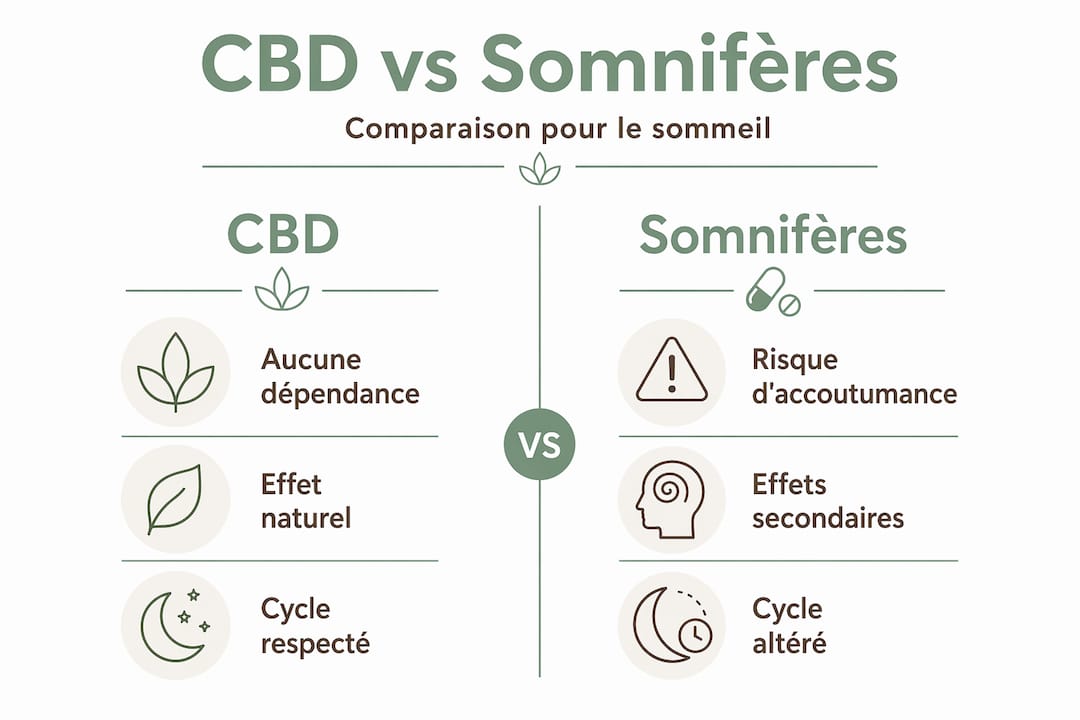
For an in-depth analysis, this CBD and sleeping pills comparison details the differences in terms of effects on sleep cycles and long-term safety.
Limitations, risks, and precautions to know
Using CBD responsibly for sleep also means knowing its limitations. CBD is not guaranteed to be effective for everyone with insomnia. Responses vary from person to person, and some people may experience little effect, even with a high-quality product and an appropriate dose.
Before using it, if you take medication, consult your doctor. CBD can interact with certain medications metabolized by cytochrome P450, particularly anticoagulants, antidepressants, and certain anti-seizure medications.
The most common side effects remain mild: excessive drowsiness (if the dose is too high), slight nausea, or bloating, especially at the beginning of use. They generally disappear after adjusting the dose.
Pro tip: If you have been suffering from chronic insomnia for more than three months, do not rely solely on CBD. This type of insomnia often responds better to cognitive behavioral therapy (CBT), recognized by sleep medicine as a first-line treatment.
A few simple rules for safe use:
- Only buy products with accessible certificates of analysis
- Never exceed 70 mg per day without medical advice
- Do not combine CBD with alcohol or anti-anxiety medication without consulting a healthcare professional first
- Keep a sleep diary to objectively assess the effects over time
My opinion on CBD as a sleep aid
by Rod
I have followed the development of the CBD market in Europe since its beginnings, and what I observe most often is the gap between expectations and reality. Many people start using CBD hoping that the first night will be transformed. When that does not happen, they conclude that it does not work and stop using it. This is the biggest mistake.
What I have learned is that CBD works best as a background support rather than a miracle solution. It creates the conditions for better sleep: a less reactive nervous system, less restless thoughts, and a less tense body. But these conditions need time to develop, and they only take hold with time and consistency.
What concerns me more is the lack of transparency surrounding some products on the market. I always stress the importance of checking certificates of analysis before making any purchase. An improperly dosed or contaminated product cannot produce reliable results, no matter how much you take.
My deep conviction is that CBD has a real place in a well-structured sleep strategy. Not instead of a doctor, not instead of good habits, but as a supplement. And for those who approach it with this mindset, the results are often forthcoming.
— Rod
Reliable CBD products for better sleep in Europe
Are you ready to take the next step and try CBD for more restorative sleep? The quality of the product you choose makes all the difference between a disappointing result and a truly improved night’s sleep.
Cbd-certified features a selection of tested and certified CBD products, with certificates of analysis available for each item. Full-spectrum sublingual oils, gummies dosed for nighttime use, extended-release capsules: each format is chosen to meet a specific need. Deliveries are available throughout the European Union, the United Kingdom, and Switzerland. Discover the best CBD shops in Europe featured by Cbd-certified, so you can sleep peacefully with CBD, with complete confidence.
FAQ
How long does it take for CBD to take effect?
The first effects on sleep generally appear after 10 to 14 days of regular use. Some people notice an improvement more quickly, while others need to wait several weeks.
Which form of CBD is most effective for sleep?
Sublingual oil is ideal for helping you fall asleep, thanks to its 15- to 45-minute onset of action. Gummies and capsules, which have a longer-lasting effect, are better suited to people who wake up during the night.
Does CBD for sleep cause dependence?
No CBD dependence is known to date, unlike with conventional sleeping pills. CBD also does not cause a rebound effect when discontinued, making it an appealing long-term option.
Can CBD and melatonin be combined?
A combination is possible, but it should be approached with caution. Consult this CBD and melatonin guide before combining the two, especially if you take other supplements or medications.
What CBD dosage should you take for insomnia?
Start with 10 to 15 mg per day and observe the effects for two weeks before adjusting. Most users find their optimal dose between 15 and 40 mg, depending on their sensitivity and the severity of their symptoms.