
Steps to verify CBD purity in 2026
In brief:
- Verifying the purity of a CBD product relies on analyzing a recent certificate of analysis (COA) accredited to ISO/IEC 17025.
- A reliable COA must present precise results for CBD, THC, and contaminants, along with a matching batch number.
The purity of a CBD product is defined as the proportion of actual cannabidiol contained in the product, measured and confirmed by an independent chemical analysis. Verifying this purity before consumption is not an optional precaution. It is the only way to ensure that what you buy corresponds to what is stated on the label. In Europe, the CBD market remains poorly harmonized, and the differences between compliant and questionable products are significant. The steps for verifying CBD purity rely on three fundamental tools: the certificate of analysis (COA), analytical methods such as HPLC, and verification of compliance with the legal THC threshold set at 0.3%.
What are the essential criteria for assessing the purity of a CBD product?
The purity of a CBD product is assessed using several precise indicators, and none is sufficient on its own. Here are the criteria to examine systematically.
-
Advertised vs. measured CBD content. A tolerance of ±10 to 15% between the stated concentration and the measured concentration is acceptable. A difference exceeding 20% is a serious warning sign. This means that a product advertised as containing 10% CBD may legitimately contain between 8.5% and 11.5%, but not 7%.
-
Legal THC threshold. The European threshold sets total THC at ≤ 0.3%, calculated using the formula: Total THC = THC + (THCA × 0.877). This formula accounts for the acidic forms of THC, which are often omitted from superficial analyses.
-
Chemical contaminants. A complete COA must include results for pesticides, heavy metals (lead, cadmium, mercury), and residual solvents. The absence of this data from a certificate is grounds for rejection.
-
Spectrum type. CBD isolates must show a purity of ≥ 98% cannabidiol. Full-spectrum or broad-spectrum products contain other cannabinoids, which is normal, but each component must be quantified.
-
Laboratory accreditations. COFRAC labels in France and the ISO/IEC 17025 standard across Europe guarantee that the laboratory follows rigorous protocols. A COA issued by a non-accredited laboratory has no evidentiary value.
Pro tip: The Organic Agriculture label certifies the hemp cultivation conditions, but does not guarantee the purity of the finished product. Only a batch-specific COA confirms the absence of contaminants in what you actually consume.

How to read and interpret a certificate of analysis (COA)?
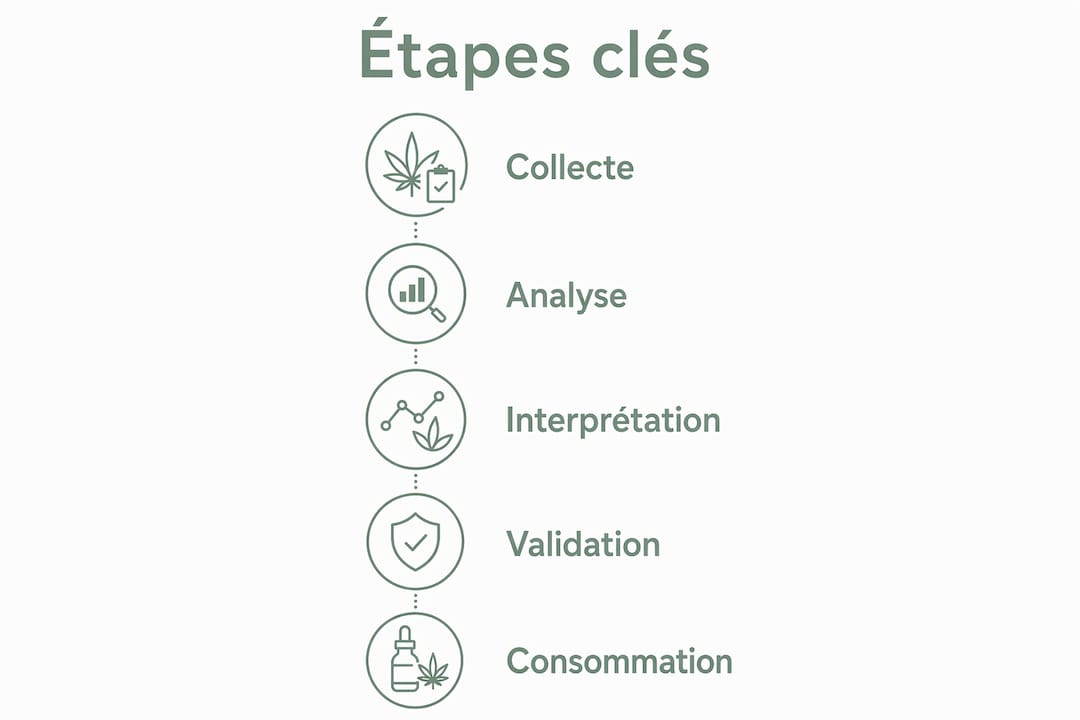
The COA (certificate of analysis) is the central document for CBD quality control. Learning to read it correctly takes less than ten minutes once you know the key elements.
Mandatory information to check
-
Laboratory name and accreditation. The laboratory must be independent and a third party separate from the manufacturer. A valid COA explicitly states the analytical method used and is issued by an ISO/IEC 17025-accredited organization.
-
Issue date. A COA must be less than 12 months old to be considered valid. An older certificate no longer reflects the actual composition of the batch being sold.
-
Batch number. This number must exactly match the one printed on your product. A generic COA without a specific batch number proves nothing about the bottle you have in your hands.
-
Complete cannabinoid profile. The levels of CBD, THC, CBG, CBN, and THCA must be listed separately. Check the total THC calculation using the formula mentioned above.
-
Contaminant results. Pesticides, heavy metals, and residual solvents must be shown with measured values, not merely the word “compliant.”
HPLC vs. GC-MS: which method should you choose?
| Method | Principle | Main advantage | Limitation |
|---|---|---|---|
| HPLC-UV/DAD | Liquid separation without heat | Precise measurement of native cannabinoids | Higher cost |
| GC-MS | Separation by vaporization | Fine solvent detection | Decarboxylates the acids and may distort the levels |
HPLC is the reference method for quantifying cannabinoids. It analyzes the molecules in their native form, without transforming them with heat. GC-MS remains useful for detecting residual solvents, but it modifies cannabinoid acids during analysis, which can lead to artificially higher THC levels.
Pro tip: If a COA does not mention the method used, ask the seller directly. A serious manufacturer provides this information without hesitation. Find more details in this guide to analyzing CBD flowers.
Warning signs of a suspicious COA
An invalid COA often has several of these characteristics: no batch number, an unknown laboratory with no verifiable accreditation, a missing date, no contaminant results, or abnormally high CBD levels without a specified testing method. If you notice any of these issues, do not consume the product.
What tools can be used to test CBD at home?
Home tests are available and can be useful in certain contexts. However, it is important to understand their limitations before relying on them.
Colorimetric kits
Colorimetric strips and kits (such as those from the Cannatest brand) work through a chemical reaction. They indicate the presence or absence of certain substances, but do not make it possible to accurately quantify CBD or THC. They are qualitative, not quantitative, tools. They do not replace certified analysis.
Portable electronic analyzers
Devices such as GemmaCert estimate cannabinoid levels using near-infrared spectroscopy. They offer useful relative accuracy for an initial screening, but their margin of error remains greater than that of an accredited laboratory. Their purchase cost is also high for occasional use.
When should these tools be used?
- Rapid tests: to check that a product does not contain an unexpected substance before first use, or for a quick check while traveling.
- Laboratory COA: for any regular purchasing decision, products intended for sensitive individuals, or validating legal compliance.
Pro tip: Rapid tests are indicative, not conclusive. Use them as an initial filter, never as the sole guarantee. For a recurring purchase, always request a complete COA.
What are the practical steps for verifying legal compliance in Europe?
Verifying a CBD product’s legal compliance follows a structured process. Here are the steps to follow in order.
-
Check the THC threshold. The total THC content must be ≤ 0.3% under European regulations, and this value must be explicitly stated in the COA with the calculation including THCA. In France, this threshold has also applied to CBD flowers and resins since 2022.
-
Check the COA date. A certificate more than 12 months old is no longer representative of the batch being sold. Always request a recent, dated, and signed document.
-
Confirm ISO/IEC 17025 accreditation. This international standard guarantees the laboratory’s technical competence. You can verify a French laboratory’s accreditation directly on the COFRAC website.
-
Cross-check the batch number. The batch number on the COA must match the one on the product packaging. Any inconsistency means that the certificate does not apply to what you purchased.
-
Check for contaminants. Pesticides, heavy metals, and residual solvents must all show values below European regulatory thresholds. The absence of this data from a COA is disqualifying.
-
Cross-check with the manufacturer’s reputation. A COA proves the chemical composition, but not the effectiveness or overall quality. Verified customer reviews and the brand’s reputation complement this verification. To go further, consult this guide to the legality of CBD in France.
Comparison table: CBD products and compliance criteria
| Product type | Expected purity | Legal maximum THC | COA required |
|---|---|---|---|
| CBD isolate | ≥ 98% | ≤ 0.3% | Yes |
| Full-spectrum oil | Variable | ≤ 0.3% | Yes |
| Broad-spectrum oil | Variable | 0% (trace amounts) | Yes |
| CBD flowers | Variable | ≤ 0.3% | Yes |
The EFSA provisional safe dose for isolates with a purity of ≥ 98% is set at 0.0275 mg/kg of body weight per day, or approximately 2 mg/day for a 70 kg person. This confirms that an isolate’s purity is not a trivial detail: it directly determines the actual dose ingested.
Key points
Verifying the purity of a CBD product requires a recent ISO/IEC 17025-accredited COA, with a matching batch number, a specified HPLC method, and complete contaminant results.
| Point | Details |
|---|---|
| Valid and recent COA | Require a certificate issued less than 12 months ago by an ISO/IEC 17025-accredited third-party laboratory. |
| Reference HPLC method | Prioritize COAs using HPLC for precise cannabinoid measurement without decarboxylation. |
| THC threshold ≤ 0.3% | Check total THC using the formula THC + (THCA × 0.877) to confirm legal compliance. |
| Limited rapid tests | Use colorimetric kits only as an initial filter, never as the sole guarantee of purity. |
| Cross-reference COAs and reputation | Supplement the chemical analysis with customer reviews and the manufacturer’s reputation to validate overall quality. |
What I learned after years of checking CBD quality
After examining dozens of COAs and following the evolution of the European CBD market, I am convinced of one thing: most consumers trust documents they do not know how to read. This is not a criticism. It is an observation that explains why so many mediocre products are still circulating in 2026.
What surprised me most over time is how often seemingly “valid” COAs conceal real shortcomings. An unaccredited laboratory can produce a perfectly formatted document. A COA without a batch number may appear complete at first glance. These details make all the difference between genuine evidence and a superficial document.
My most practical advice: don’t look at the CBD content first. First, look at the laboratory’s name, then verify its accreditation online. If this step fails, the rest of the document has no value. Checking CBD quality starts there, not with the figures.
I also think that the combination of HPLC and GC-MS represents the future of CBD analysis. Analytical transparency combining HPLC and GC-MS is essential for detecting invisible contaminants. Serious brands are already adopting it. In 2026, a COA that uses only one method should make you cautious.
— Rod
Where can I buy certified and tested CBD in Europe?
Cbd-certified selects only products accompanied by complete COAs, issued by accredited and verifiable laboratories. Every batch is traceable, and every certificate is accessible before purchase.
Whether you are in France, Belgium, the Netherlands, or Switzerland, Cbd-certified delivers throughout the European Union, the United Kingdom, and Switzerland. The platform lists the best CBD shops in Europe with verifiable purity and compliance guarantees. Choosing a certified seller means ensuring that the verification work has already been done for you, according to standards that you can check yourself.
Frequently asked questions
What is a COA and why is it essential?
A COA (certificate of analysis) is a document issued by an independent laboratory that confirms the chemical composition of a CBD product. Without an ISO/IEC 17025-accredited COA, it is impossible to verify a product’s actual purity.
What tolerance is acceptable between the advertised and measured levels?
A difference of ±10 to 15% between the advertised CBD level and the measured level is considered normal. Above a 20% difference, the product does not meet the expected quality standards.
Are at-home tests reliable for checking CBD purity?
Colorimetric kits and portable analyzers are indicative, not quantitative. They detect the presence of certain substances but cannot confirm legal compliance or the precise CBD concentration.
How can I verify that the THC level in my CBD product is legal?
Apply the formula total THC = THC + (THCA × 0.877) to the COA values. The result must be less than or equal to 0.3% to comply with European and French regulations.
Does an organic label guarantee the purity of a CBD product?
No. The Organic Farming label certifies the hemp cultivation conditions, but it does not guarantee the purity or CBD concentration of the finished product. Only a batch-specific COA provides this proof.