
CBD Trust Labels: Key Certifications in 2026
In short:
- Trusted private CBD labels combine organic certifications, laboratory analyses, and manufacturing standards to guarantee quality.
- No official European label specifically for CBD exists in 2026, making verifiable private certifications essential.
- You should verify the validity of the certificate of analysis, the laboratory's compliance, and the presence of GMP or ISO 22000 standards to guarantee a reliable product.
Trusted CBD labels are private certifications that combine organic labels, accredited laboratory analyses, and manufacturing standards to guarantee product quality and safety. In 2026, no official European label specifically for CBD exists. Consumers must therefore rely on a combination of private certifications: the Organic Agriculture label (AB), COA certificates of analysis, and GMP or ISO 22000 standards. Only this cross-checking approach provides a genuine guarantee of what you consume.
1. What are the main organic labels for CBD hemp?
Organic labels certify the agricultural practices used to cultivate hemp. They are the first layer of verification for any serious CBD product.
- Organic Agriculture Label (AB): this French label, recognized throughout the European Union, certifies that the plant is free from pesticides and GMOs. It covers only hemp cultivation, not processing or the finished product.
- Euro-leaf (Euro-leaf): this is the European Union's official organic logo. It imposes the same requirements as the AB label and applies to all organic agricultural products sold in Europe. Its presence on CBD packaging confirms cultivation compliant with European regulations.
- Ecocert: this French certification body can cover the entire finished CBD product, particularly oils, when all production stages meet strict organic criteria. It is one of the few certifications that extends beyond simple cultivation.
- Cosmébio: for CBD products intended for cosmetic use, this label guarantees a formulation that meets strict organic and natural criteria. It is particularly relevant for CBD balms, creams, and serums.
These organic labels are a solid foundation. However, they do not guarantee the purity or CBD concentration in the finished product. Hemp grown without pesticides can still produce an improperly dosed oil or become contaminated during extraction.
Professional tip: Check that the organic label displayed corresponds to the certifying body mentioned on the packaging. An AB logo without a verifiable certificate number is a warning sign.
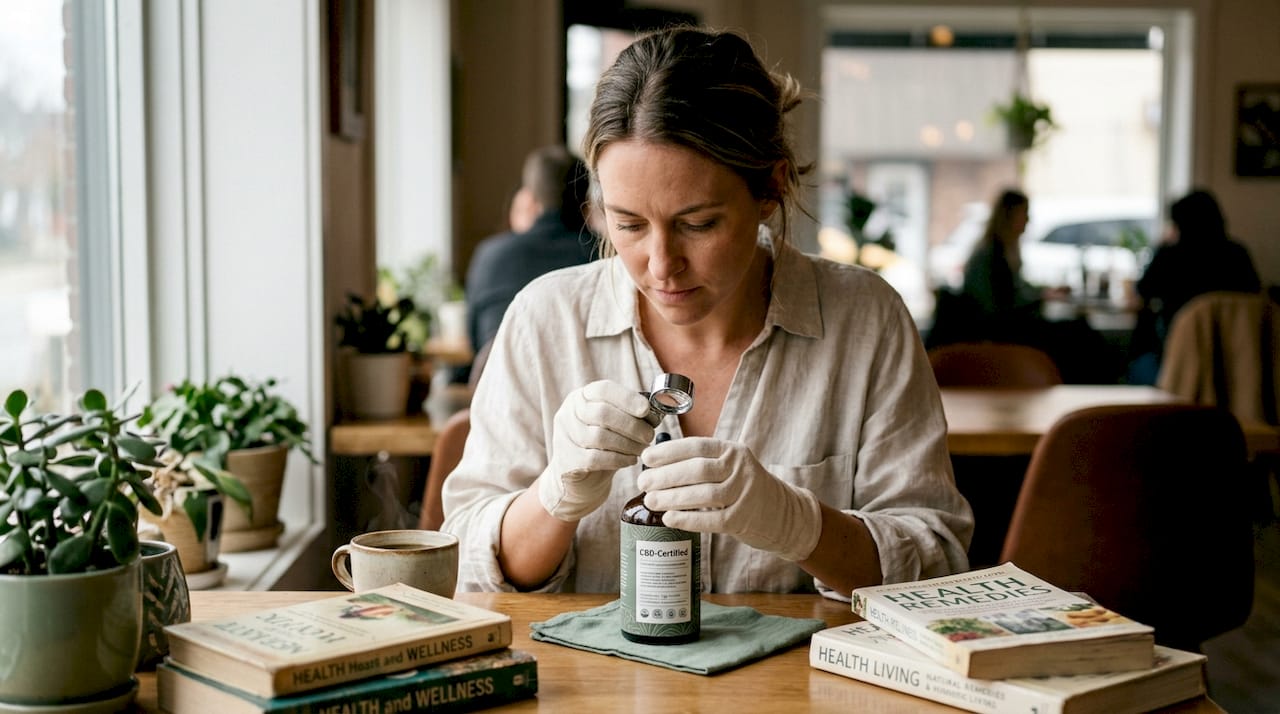
2. Why are COA certificates of analysis essential?
A certificate of analysis (COA, from the English Certificate of Analysis) is a document issued by an independent laboratory that details the exact composition of a batch of CBD product. It is the most reliable verification tool available to consumers.
According to a MILDECA study, 81% of the CBD products tested showed cannabinoid levels that did not comply with those indicated on the label. This figure illustrates the scale of the problem: without a COA, you do not know what you are actually buying.
A credible COA must contain the following elements:
- CBD level: the actual concentration must match what is stated on the packaging.
- THC level ≤ 0.3%: this is the legal limit currently in force in the European Union and the United Kingdom. Exceeding it makes the product illegal.
- Heavy metals: lead, cadmium, mercury, and arsenic must be absent or below regulatory thresholds.
- Pesticides: their presence invalidates any organic claim and poses a direct health risk.
- Residual solvents: some extraction processes use chemical solvents. Any residue in the finished product is unacceptable.
- Batch number: the number shown on the COA must exactly match the one printed on your bottle or packaging.
A valid COA is dated, signed, and issued by an ISO 17025-accredited laboratory. ISO 17025 accreditation guarantees that the laboratory follows rigorous protocols and that its results are reliable and reproducible.
To explore COA interpretation further, the practical guide to COAs from Cbd-certified explains every line of these documents with concrete examples.
Professional tip: A COA dated more than 12 months ago is obsolete. Each new production batch must undergo a new analysis. Always request the COA corresponding to the batch you are purchasing.
To understand the differences between the compounds analyzed in a COA, particularly between THCA and CBD, this guide to THCA and CBD offers a clear explanation.
3. Which manufacturing standards guarantee the quality of the finished product?
Agricultural certifications protect hemp cultivation. Manufacturing standards, on the other hand, guarantee what happens after harvesting: extraction, formulation, packaging, and quality control.
- Good Manufacturing Practices (GMP): these standards define the minimum production conditions needed to ensure product safety and consistency. They cover facility cleanliness, raw material traceability, and staff training. GMP is mandatory for medicines and strongly recommended for food supplements and CBD products.
- ISO 22000: this international standard covers food safety throughout the production chain. It requires risk analysis at every stage and applies directly to CBD oils and supplements intended for consumption.
- API Facility Ready: this certification represents the new pharmaceutical standard in CBD manufacturing. It guarantees a level of control close to that required for medicines. Manufacturers that obtain it demonstrate rigor well beyond standard GMP requirements.
| Standard | Scope | What it guarantees |
|---|---|---|
| GMP | Manufacturing | Production conditions, traceability, consistency |
| ISO 22000 | Food safety | Risk analysis, production chain |
| API Facility Ready | Pharmaceutical standard | Maximum control, near-pharmaceutical quality |
These certifications are not always shown on the packaging. Look for them on the brand's official website, under the “About” or “Quality” section. A reputable brand highlights them without hesitation.
4. How do you combine these labels to choose a reliable brand?
No single label is enough. Combining organic labels, COAs, and GMP/ISO standards is the only approach that covers the entire value chain of a CBD product. Here's how to do it in practice.
- Verify the crop's organic certification: look for the AB, Euro-leaf, or Ecocert label on the packaging. Note the certificate number and verify it on the certifying organization's website.
- Request the COA for the current batch: every reputable brand publishes its COAs online or provides them upon request. If a brand refuses or does not have a recent COA, look elsewhere.
- Check the laboratory’s accreditation: the laboratory that issued the COA must be ISO 17025 accredited. In France, the relevant accreditation body is COFRAC (French Accreditation Committee). Verify the accreditation directly on the COFRAC website.
- Look for manufacturing standards: BPF/GMP, ISO 22000, or API Facility Ready on the brand’s website. This information should be accessible and verifiable.
- Distinguish genuine labels from marketing claims: “premium,” “natural,” or “clean” are not certifications. These terms entail no legal obligation and prove nothing about the product’s actual quality.
The laboratory analyses published by batch provide stronger evidence than all marketing claims when it comes to quality. Analytical transparency is the most decisive criterion for identifying a reliable brand.
Professional tip: Compare the batch number on your packaging with the one shown on the downloaded COA. If they do not match, the certificate does not apply to your product.
To take your selection process further, the guide to choosing suitable CBD from Cbd-certified details each step with practical examples.
5. What are the risks of relying solely on marketing claims?
Marketing claims without genuine certification expose consumers to concrete risks. The MILDECA study cited above confirms this: 81% of the CBD products tested did not match their labels. This is not a marginal anomaly. It is the norm in a poorly regulated market.
- Overdosing or underdosing: a product advertised as containing 10% CBD may contain 3% or 18%. Both situations are problematic, one for effectiveness and the other for safety.
- Presence of contaminants: without a COA, there is no guarantee that the product you consume is free from pesticides, heavy metals, or residual solvents.
- Exceeding the legal THC threshold: an untested product may contain more than 0.3% THC, making it illegal and potentially psychoactive.
- Fake labels: some packaging displays logos that resemble official certifications without actually being them. A green logo with a leaf does not replace a verifiable certificate number.
Marketing labels such as “premium,” “natural,” or “clean” do not constitute official guarantees. Only transparent analytical testing, validated by an independent laboratory, ensures genuine confidence in a CBD product.
Consumer vigilance remains the best filter in this market. Demanding a COA before buying is a simple habit that eliminates the vast majority of questionable products. To learn more about CBD quality criteria in Europe, Cbd-certified’s CBD quality guide for Europe offers a clear overview.
Key points
The most reliable CBD trust labels combine verifiable organic certification, a COA issued by an ISO 17025-accredited laboratory, and GMP or ISO 22000 manufacturing standards, because none of these elements alone covers the entire quality chain.
| Point | Details |
|---|---|
| No official European label | No specific government certification for CBD exists in 2026; combine several private labels. |
| The organic label is not enough | AB and the Euro-leaf cover only hemp cultivation, not the purity of the finished product. |
| The COA is essential | Demand a recent, dated, signed COA issued by an ISO 17025-accredited laboratory for every batch. |
| GMP and ISO 22000 standards matter | They guarantee rigorous manufacturing conditions beyond simple organic cultivation. |
| Marketing is not proof | “Premium,” “natural,” or “clean” entail no legal obligation regarding actual quality. |
What I learned from closely observing this market
The European CBD sector has matured quickly, but not uniformly. What still strikes me today is the number of consumers who trust a green logo without ever checking what it actually represents.
I have seen brands proudly display an “organic” label on their packaging even though their COA was nowhere to be found or was two years old. Organic certification provides visual reassurance, but it says nothing about what happens after harvesting. Extraction, formulation, packaging: all of this falls outside the AB label.
What convinced me was the rise of pharmaceutical certifications such as API Facility Ready. When a manufacturer reaches this level, it can no longer hide behind vague marketing. Every batch is traceable, every analysis is public. This is the level of rigor consumers should demand systematically.
My conviction: analytical transparency is worth more than any logo. A brand that publishes its COAs for every batch, with a verifiable accredited laboratory number, deserves your trust far more than a brand that accumulates visual labels without evidence behind them. Demand proof. Good brands already have it ready.
— Rod
Cbd-certified selects certified products for you
Cbd-certified applies the criteria described in this article to every product listed on its platform: verified organic labels, batch-accessible COAs, and controlled manufacturing standards. The selection covers the European Union, the United Kingdom, and Switzerland, with deliveries available in all three areas.
Cbd-certified lists the best certified CBD shops in Europe according to criteria for analytical transparency and regulatory compliance. Each listed store has been evaluated based on the availability of its COAs, the clarity of its certifications, and the compliance of its products with legal THC thresholds. It is a reliable starting point for any informed purchase.
Frequently asked questions
What is a trusted CBD label?
A trusted CBD label is a private certification (organic, GMP, ISO, or COA) attesting to the quality and safety of a CBD product. No specific official European government CBD label exists in 2026.
Does the organic label guarantee CBD quality?
No. The AB label or the Euro-leaf only certify the absence of pesticides in hemp cultivation. They do not cover purity, CBD concentration, or the absence of contaminants in the finished product.
How can you check whether a COA is authentic?
Check that the laboratory is ISO 17025 accredited, that the test date is recent, and that the batch number on the COA exactly matches the one on your packaging. To learn more, see this guide to certificates of analysis.
What is the legal THC limit in CBD in Europe?
The legal limit is 0.3% THC in CBD products sold in the European Union and the United Kingdom. Any product exceeding this threshold is considered illegal.
What does API Facility Ready certification mean for a CBD manufacturer?
The API Facility Ready certification indicates that the manufacturer complies with production standards close to pharmaceutical requirements. It is currently the highest level of certification available in the CBD industry, exceeding standard GMP requirements.