
Understanding broad-spectrum CBD: definition and benefits
TL;DR:
- Broad-spectrum CBD contains most of the hemp’s compounds with no detectable THC.
- It is ideal for Europeans subject to drug tests or wishing to avoid THC.
- Studies show that CBD may help reduce anxiety and improve sleep.
Choosing between full-spectrum, broad-spectrum, or isolate CBD can seem complex, especially when you simply want to sleep better or reduce your anxiety. In Europe, the issue is even more sensitive: strict THC regulations lead many consumers to wonder whether a THC-free product can really be effective. Broad-spectrum CBD often represents the most suitable answer in this context. This article explains exactly what it contains, why it is particularly relevant for European users, and what science actually says about its effects.
Table of contents
- What is broad-spectrum CBD?
- Why choose broad spectrum in Europe?
- Comparison: broad-spectrum, full-spectrum, isolate
- Effects on anxiety and sleep: what the science says
- Our perspective on broad-spectrum CBD
- Where can you get high-quality broad-spectrum CBD?
- Frequently asked questions about broad-spectrum CBD
Key Points
| Point | Details |
|---|---|
| Clear definition | Broad-spectrum CBD combines numerous cannabinoids other than THC for a legal entourage effect. |
| European safety | Ideal for complying with strict European THC regulations and avoiding positive test results. |
| Balanced choice | Broad-spectrum CBD offers the best balance of effectiveness, synergy, and safety for anxiety and sleep. |
| Know your needs | Choose your type of CBD based on your sensitivity to THC, your health needs, and the local legal context. |
What is broad-spectrum CBD?
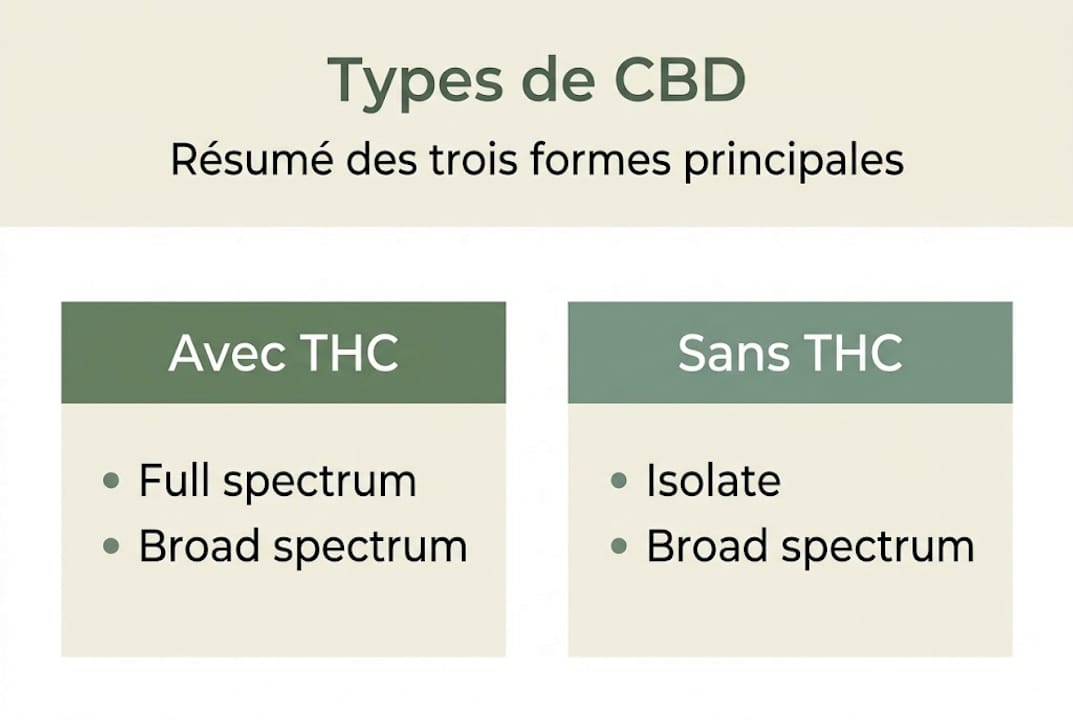
Broad-spectrum CBD is a form of hemp extract that contains most of the plant’s natural compounds, except THC (tetrahydrocannabinol), the cannabinoid responsible for psychoactive effects. It falls between two other well-known forms: full-spectrum and isolate.
There are several forms of CBD on the market, each with its own characteristics. Here’s how to compare them:
| Form | CBD | THC | Other cannabinoids | Terpenes |
|---|---|---|---|---|
| Full-spectrum | Yes | Yes (traces) | Yes | Yes |
| Broad-spectrum | Yes | No (removed) | Yes | Yes |
| Isolate | Yes | No | No | No |
Broad-spectrum CBD is made from a complete hemp extract, which is then subjected to a filtration or chromatography process to remove THC. The result is a product that retains secondary cannabinoids such as CBG, CBN, and CBC, as well as aromatic terpenes, the molecules that give each strain its distinctive scent profile.

These compounds act synergistically with CBD. This is known as the entourage effect, a phenomenon whereby hemp molecules enhance one another to produce a more complete effect than CBD alone.
Why does this matter to you? Because users seeking relief from anxiety or improved sleep benefit from this molecular richness without taking the risk associated with THC. As Medical News Today explains, broad spectrum contains most of the plant’s compounds, with no detectable THC.
Here is what a quality broad spectrum extract generally contains:
- CBD: the main cannabinoid
- CBG (cannabigerol): associated with anti-inflammatory and relaxing properties
- CBN (cannabinol): often associated with sleep-promoting effects
- Terpenes such as linalool or myrcene: modulators of the overall effect
- Flavonoids: natural antioxidants found in the plant
Broad spectrum offers the richness of full spectrum with the peace of mind of a THC-free profile. It is often the ideal compromise for European consumers concerned about legal compliance.
Why choose broad spectrum in Europe?
In Europe, CBD regulations are constantly evolving, but one point is widely agreed upon: THC must be kept at very low levels. The legal limit is generally set at 0.2% or 0.3% THC, depending on the country. Some member states even have stricter rules, and workplace drug tests can detect THC even at trace concentrations.
This is where broad spectrum truly comes into its own. According to Medical News Today, this type of product is ideal for avoiding THC due to strict regulations or requirements related to drug testing. To learn more about the legal framework, see our article on CBD legality in Europe.
Which user profiles are most concerned?
- People subject to urine or blood tests in the workplace
- Consumers sensitive to THC who experience anxiety or paranoia with full spectrum
- Those seeking an entourage effect without the legal risks associated with THC
- Beginners looking for a gentle introduction to the world of CBD
For anxiety and insomnia in particular, broad spectrum is often recommended because it preserves terpenes and secondary cannabinoids that contribute to a calming effect, while remaining within a comfortable legal framework.
Key statistic: In a survey published in 2023, approximately 60% of European CBD users said they chose their products based on legal compliance and the absence of THC.
Pro tip: Before buying a broad-spectrum product, always request the certificate of analysis (CoA) from an independent laboratory. This document confirms the exact levels of THC, CBD, and other compounds. A reputable seller will always make it available without delay.
Comparison: broad-spectrum, full-spectrum, isolate
Choosing the right form of CBD depends on your personal profile, your goals, and the regulatory context in which you operate. Here is a practical decision guide.
| Criterion | Full-spectrum | Broad-spectrum | Isolate |
|---|---|---|---|
| THC present | Yes (< 0.2%) | Not detectable | No |
| Entourage effect | Maximum | Partial | Absent |
| Test safety | Low risk | Very safe | Completely safe |
| Aromatic profile | Rich | Rich | Neutral |
| Recommended for | Advanced therapeutic uses | Anxiety, sleep, daily use | Sensitivity to hemp |
A few points to help refine your choice:
- You are subject to drug tests: broad-spectrum CBD or isolate are your only safe options.
- You are looking for the most powerful effect: full-spectrum CBD maximizes the entourage effect but carries a residual risk of THC, even if minimal.
- You are new to CBD: broad-spectrum CBD is an excellent starting point—balanced and reassuring.
- You are sensitive to hemp compounds: isolate, which contains only pure CBD, minimizes the risk of a reaction.
According to rethinkTHC, broad-spectrum CBD may be less effective than full-spectrum CBD for some users, but its benefit-risk profile is more neutral, making it a particularly sensible choice for the vast majority of European consumers.
For those who wish to explore the data on reducing anxiety with CBD in greater depth or explore the therapeutic use of CBD, these resources provide solid clinical insight.
Pro tip: Don’t choose based on price alone. A well-formulated broad-spectrum product costs more to produce than an isolate because the extraction process is more complex. A very inexpensive product should raise your suspicions.
Effects on anxiety and sleep: what the science says
The question that comes up most often: does it really work? The short answer is yes, with important nuances to be aware of.
Available studies point to positive effects of CBD on anxiety and sleep disorders. Here is an overview of the current data:
| Condition | Observed results | Level of evidence |
|---|---|---|
| Generalized anxiety | Reduced anxiety scores | Moderate (clinical studies) |
| Insomnia | Improved sleep duration and quality | Preliminary |
| Post-traumatic stress | Reduction of certain symptoms | Exploratory |
| Social anxiety | Positive effects on public speaking | Moderate |
The mechanisms of action primarily involve the endocannabinoid system, which regulates essential functions such as mood, the sleep-wake cycle, and the stress response. CBD interacts with this system without directly binding to CB1 receptors as THC does.
What European users report:
- A gradual feeling of calm 30 to 60 minutes after taking it
- Improved sleep, particularly fewer nighttime awakenings
- Better management of daily stress without drowsiness the next day
- Variable results depending on the dose and consistency of use
As Medical News Today points out, empirical data support CBD for anxiety and sleep, but additional randomized clinical studies are still needed to confirm these results on a large scale.
This means that broad-spectrum CBD is not a medicine in the regulatory sense. It is a supplement that may support your well-being, but it does not replace medical care in cases of severe disorders.
To learn more, explore the links between CBD and mental health, discover how to add CBD to your daily routine, or consult our recommendations on CBD dosage for insomnia and anxiety.
Our perspective on broad-spectrum CBD
We often see a tendency to pit broad spectrum against full spectrum as if one were universally superior to the other. That is not how we see it. Broad spectrum is not an inferior version of full spectrum: it is an option designed for a specific context, and that context is exactly the one faced by the majority of European consumers in 2026.
The real question is not “which format is the most powerful?” but “which format fits my actual situation?” If you are subject to legal or professional restrictions, if THC makes you nervous rather than calm, or if you simply want a reliable, traceable option, broad spectrum is often the right choice.
What we recommend: require up-to-date certificates of analysis, check that the product is extracted from certified European hemp, and consult a healthcare professional if your anxiety or insomnia is chronic. For an overview of CBD uses in 2026, we invite you to explore our other resources.
Where can you get high-quality broad-spectrum CBD?
Finding reliable broad-spectrum CBD requires some vigilance. The essential criteria are traceability of the raw material, certification of the analyses, and customer service capable of answering your questions about the product’s composition.
European CBD Shop selects broad-spectrum products that comply with European regulations, with laboratory analyses available for each product. Whether you are in France, Belgium, Switzerland, or the United Kingdom, you can browse our selection of the best CBD shops in Europe and access clear information about shipping and returns. Transparency is not a bonus for us: it is the foundation of every trusting relationship with our customers.
Frequently asked questions about broad-spectrum CBD
Does broad-spectrum CBD really contain zero THC?
Broad-spectrum CBD is designed to eliminate THC, but as rethinkTHC points out, trace amounts are possible depending on the manufacturing processes. If you are subject to strict drug testing, choose a certified isolate or request a detailed certificate of analysis.
Can broad-spectrum CBD be used for anxiety or insomnia?
Yes, current data is encouraging: according to Medical News Today, empirical evidence supports CBD for anxiety and sleep, although more randomized clinical trials are still needed to establish formal recommendations.
Is broad-spectrum suitable for all profiles of European users?
It is particularly suitable for those who want to benefit from the entourage effect while limiting exposure to THC. According to Medical News Today, it is ideal for avoiding THC in European regulatory contexts, provided you check the traceability and purity of the chosen product.
How does it differ from isolate?
Isolate contains only pure CBD, with no other cannabinoids or terpenes. As Medical News Today indicates, this limits the synergistic effect between hemp compounds, which may reduce overall effectiveness for uses targeting anxiety or sleep.