
CBD Guide for Beginners: Pain, Anxiety, Insomnia
TL;DR:
- The legality of CBD in Europe depends on a THC content below 0.3%.
- It is essential to choose quality products with a certificate of analysis and European origin.
- Starting with low doses and increasing slowly promotes a safe and effective first experience.
Many people suffering from chronic pain, anxiety, or sleep disorders turn to CBD with hope, but without really knowing where to start. What dose should you choose? Which product should you buy? Is it legal in your country? This guide takes you step by step, from selecting the right product to monitoring your initial results, with clear guidelines, practical advice, and essential warnings to make your first CBD experience as safe and informed as possible.
Table of contents
- Preparing for your first experience: choosing your product and checking its legality
- Initial dosage and method of administration: step by step according to your needs
- Precautions, Side Effects, and Safety Advice
- Expected results, managing expectations, and tracking your experience
- Our perspective: why a gradual approach is essential for getting started properly
- Where to find reliable CBD products for beginners
- Frequently Asked Questions About the First CBD Experience
Key Points
| Point | Details |
|---|---|
| Choose a safe product | Choose labeled, tested products that comply with European legislation (<0.3% THC). |
| Start with a low dose | Start with 5–10 mg for pain, 10 mg for anxiety, then adjust according to how you feel. |
| Plan for side effects | Drowsiness or digestive problems are possible; pay attention to the dosage and drug interactions. |
| Gradual results | The effects of CBD generally appear over several days to weeks, so patience is required. |
| Personalized monitoring | Keep an observation journal to record the effects and adjust your use accordingly. |
Preparing for your first experience: choosing your product and checking its legality
Before even considering dosage, you need to make sure that the product you buy is legal, reliable, and suited to your needs. This is not a step to overlook, as the CBD market in Europe remains poorly regulated in some respects.
CBD legality in Europe: what you need to know
In Europe, CBD (cannabidiol) is legal provided that products contain less than 0.3% THC, the psychoactive molecule in cannabis. This applies to France, Germany, Belgium, Switzerland, and most European Union countries. Consult the CBD legal guide to learn about the nuances specific to each country before making a purchase.
It is also important to know that the ANSM warns about interactions with other medications, with 58 cases reported between 2017 and 2023. CBD is therefore not harmless, even though it is sold freely.
Identify a quality product
A quality CBD product can be identified by several objective criteria. To identify quality CBD, here are the essential points to check:
- Independent laboratory analysis (COA): the product must be accompanied by a certificate of analysis detailing cannabinoid concentrations and the absence of pesticides or heavy metals.
- Plant origin: choose hemp grown in Europe, subject to strict agricultural standards.
- THC content clearly displayed: it must be below 0.3% to remain within the European legal framework.
- Product spectrum: full spectrum, broad spectrum, or CBD isolate; each option offers different advantages depending on your profile.
- Clear and complete label: ingredients, CBD concentration, recommended dosage, expiration date.
Comparison of CBD product types for beginners
| Product type | Mode of action | Time to take effect | Ease of use | Ideal for |
|---|---|---|---|---|
| Sublingual oil | Rapid absorption | 15 to 45 min | Easy, precise dosing | Anxiety, pain |
| Capsules | Digestion | 1 to 2 hours | Very practical | Insomnia, daily use |
| CBD flowers (vaporization) | Lungs | 5 to 15 min | Requires equipment | Acute pain, rapid relaxation |
| Topicals (creams) | Localized, skin | 20 to 60 min | Very simple | Localized joint pain |
To secure your purchase, learn about the secure CBD purchasing process to avoid scams and non-compliant products.
Pro tip: Beware of products sold at very low prices without a certificate of analysis. Quality CBD has real production costs. If the price seems too attractive, it is often a warning sign.
Initial dosage and method of administration: step by step according to your needs
Once you have carefully chosen the product, let’s move on to precise dosing and administration, a key element of a successful first experience.
The golden rule: start low, increase slowly
The universal principle for getting started with CBD is called “start low, go slow.” There is no universal dose, as each body reacts differently depending on weight, metabolism, sensitivity to cannabinoids, and the condition being targeted.
Here is how to progress according to your main goal:
- Week 1: start with 5 mg of CBD per dose, twice a day (morning and evening).
- Week 2: if no adverse effects are observed and the effects are insufficient, increase to 10 mg per dose.
- Week 3: if necessary, gradually increase to 20 to 25 mg per dose, adjusting according to how you feel.
- Week 4 and beyond: maintain the minimum effective dose that produces the desired effect without discomfort.
Recommended dosages by condition
| Indication | Initial dose | Usual dose | Maximum studied dose |
|---|---|---|---|
| Chronic pain | 5 to 10 mg | 15 to 30 mg | Varies by study |
| Anxiety | 10 mg/day | 20 to 50 mg | up to 300 mg/day in some studies |
| Insomnia | 10 mg in the evening | 20 to 40 mg | 40 to 60 mg |
| Joint pain | 5 to 10 mg | 15 to 25 mg | Variable |
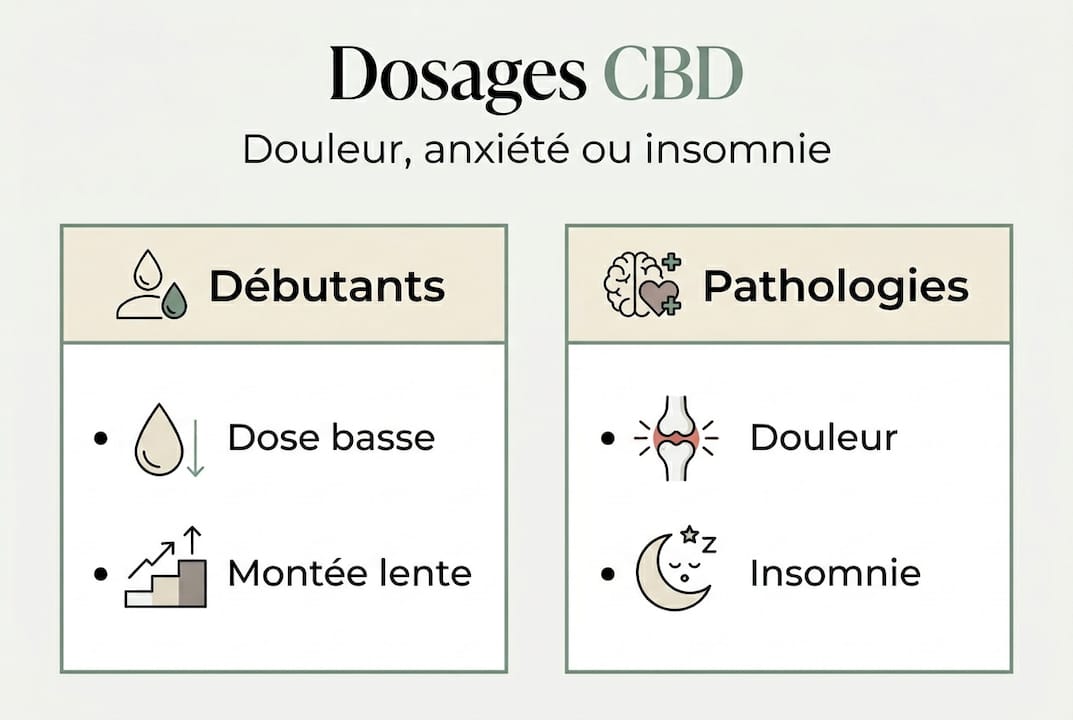
For chronic pain, recommendations suggest starting with 5 to 10 mg per initial dose, increasing gradually. Neuropathic and joint pain seem to respond in particular thanks to CBD’s indirect anti-inflammatory effect and improved pain tolerance, although study results remain heterogeneous.
For anxiety, CBD acts via 5-HT1A serotonin receptors, with measured relaxing effects. Doses generally start at 10 mg/day, but studies have explored up to 300 mg/day for severe forms of anxiety. Effectiveness varies from person to person.
“CBD is not a medicine under European regulations. Its use should be considered as a complement to comprehensive care, not as a substitute for an established medical treatment.”
To refine your personal approach, the guide to finding the right CBD dosage for your profile remains a useful resource. And to take things further in practice, see the advice on using CBD effectively.
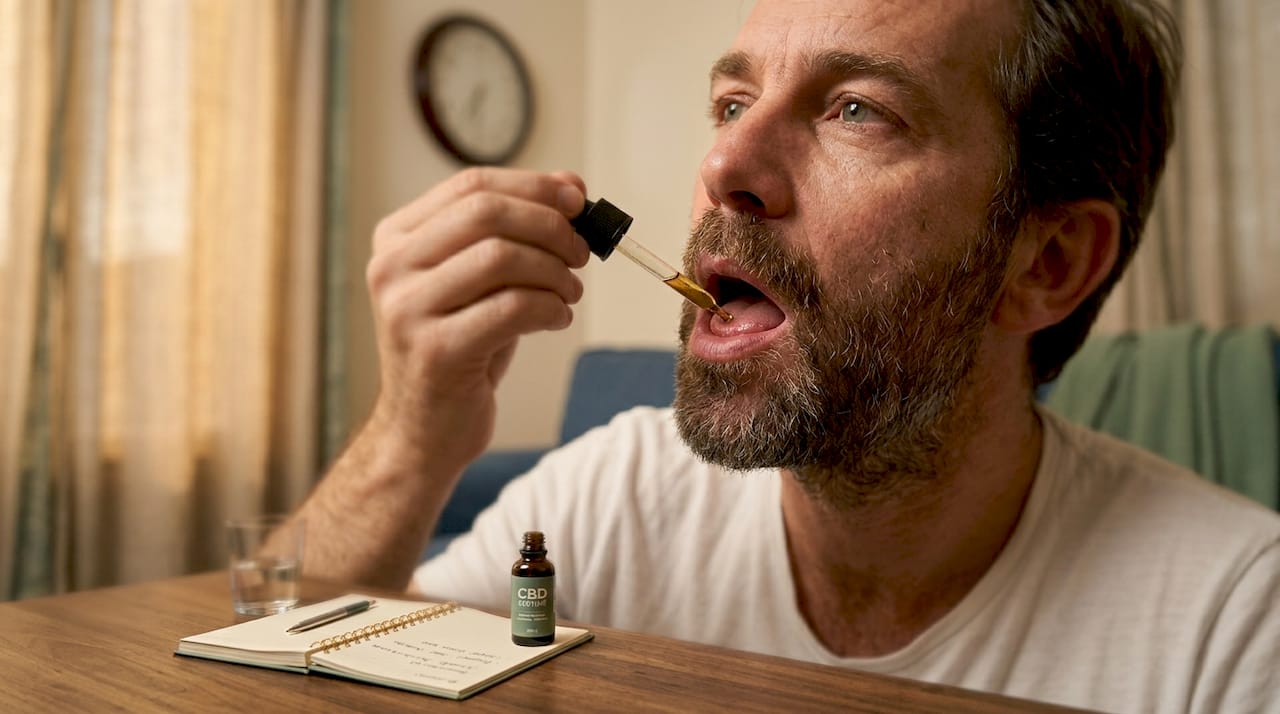
Pro tip: Place your CBD oil under your tongue and hold it there for 60 to 90 seconds before swallowing. This sublingual technique allows faster and more complete absorption than swallowing it directly.
Precautions, Side Effects, and Safety Advice
Dosage is only one part of the experience: it is crucial to anticipate all potential precautions and risks before getting started.
Possible Side Effects
CBD is generally well tolerated, but some side effects may occur, especially at the beginning or in the event of an overdose. These effects are dose-dependent and often lessen when the dose is reduced:
- Drowsiness: especially at high doses or when combined with sedatives.
- Dry mouth: common and easily managed by drinking more water.
- Digestive problems: mild nausea and possible diarrhea at the beginning of use.
- Mild hypotension: especially in sensitive or older people.
- Temporary fatigue: may occur while adjusting to the initial doses.
Drug Interactions: Essential Vigilance
CBD inhibits certain liver enzymes responsible for metabolizing many medications. This can alter the concentration of these substances in your blood, with unpredictable consequences. Drug interactions notably concern:
- Antiepileptic drugs (valproate, phenytoin, carbamazepine)
- Benzodiazepines (diazepam, lorazepam)
- Anticoagulants (warfarin)
- Immunosuppressants
- Certain antidepressants
Important: if you take any of these medications, you must consult your doctor before incorporating CBD into your routine. This is not merely a formal precaution; it is a genuine clinical necessity.
Situations in Which CBD Is Not Recommended
Certain categories of people should avoid CBD or use it under strict medical supervision. Pregnancy and breastfeeding are among the main contraindications, as the effects on the fetus and infant have not been sufficiently studied. Driving a vehicle immediately after taking a high dose of CBD is also discouraged, given the possible drowsiness.
To learn more about prolonged use, the article on CBD without habituation explains why the risk of dependence remains low, while detailing best practices for long-term use.
Pro tip: Keep a log from your first dose. Note the time, dose, product, and how you feel 30 minutes, 2 hours, and 4 hours afterward. This will help you quickly identify what is or is not working.
Expected results, managing expectations, and tracking your experience
After the warnings, here is how to proceed to evaluate and adjust your expectations during the first few weeks.
The effects are not immediate
One of the most common mistakes among new users is giving up too soon, convinced that CBD “doesn’t work,” after only a few days. In reality, the effects are gradual, and it often takes between 1 and 3 weeks to observe significant changes, particularly for chronic pain or insomnia. Individual variability related to weight, metabolism, and endocannabinoid sensitivity plays an important role.
Here are the realistic guidelines to keep in mind:
- Days 1 to 7: adjustment phase, with few noticeable effects and possible slight drowsiness.
- Weeks 2 to 3: initial signs of possible improvement (better sleep quality, slight stress reduction).
- Weeks 4 to 8: more stable effects if the dose is properly adjusted and use is regular.
- Beyond 2 months: a comprehensive evaluation is recommended, with adjustments to the strategy.
Combining CBD with an appropriate lifestyle
CBD does not replace a healthy lifestyle. For sleep problems, combining CBD with practices such as reducing screen time in the evening, keeping regular schedules, and maintaining a calm sleep environment enhances the benefits. For chronic pain, combining CBD with complementary therapies (physical therapy, meditation, natural anti-inflammatories) produces better results than CBD alone.
The benefits of CBD flowers for anxiety, sleep, and pain are documented, with faster action thanks to vaporization. To understand how CBD fits into a broader care framework, therapeutic use of CBD in Europe is also a useful complementary read.
Pro tip: Use a sleep-tracking app or a simple health journal. Compare your data week by week. Improvements in sleep quality are often subtle but measurable over the long term.
Our perspective: why a gradual approach is essential for getting started properly
At European CBD Shop, we have supported thousands of customers as they took their first steps with CBD. What we observe most often is the gap between initial expectations and clinical reality. CBD industry marketing sometimes talks about spectacular, almost immediate results. The reality, confirmed by official health sources, is more nuanced.
CBD can provide real support for anxiety, insomnia, or chronic pain. But clinical evidence remains mixed, and what works for one person may have no effect on another. This is not a weakness of CBD; it is the nature of the human endocannabinoid system, which is deeply individual.
Our conviction, shaped by experience and feedback from our customers, is that a gradual approach is the only truly effective one. Start slowly, observe, adjust. It is not the most exciting method, but it produces the best lasting results. Users who give up after a week, often because nothing happened immediately, miss out on real potential.
We also emphasize the importance of cross-checking sources: positive testimonials are encouraging, but they do not replace personalized medical advice. For questions about anxiety and stress reduction, clinical evidence is beginning to emerge, but it requires critical evaluation. Personalized monitoring, patience, and honesty with yourself about the results you observe make all the difference between a disappointing experience and a genuine life change.
Where to find reliable CBD products for beginners
You now have everything you need to approach your first CBD experience with confidence and method. The practical question remains: where can you buy compliant, laboratory-tested products suited to your specific needs?
European CBD Shop selects products with independent certificates of analysis, verified THC levels, and traceable origins. Whether you are in France, Belgium, Switzerland, or the United Kingdom, our deliveries cover all of Europe and the United Kingdom. If you are looking for a specific option to get started, our super-relaxing CBD oil is particularly popular with new users for its accessible concentration and effectiveness for anxiety and sleep. For those who travel or want to discover physical stores, also explore our selection of the best CBD shops in London.
Frequently Asked Questions About the First CBD Experience
How long does it take to feel the effects of CBD during a first trial?
The effects of CBD generally appear within 1 to 3 weeks, depending on individual sensitivity, metabolism, and adherence to gradually increasing doses. A shorter timeframe is possible with vaporization or sublingual oil, but lasting effects develop over time.
Can CBD cause side effects from the first dose?
Yes, drowsiness, dry mouth, and digestive problems may occur from the first dose, especially if the dose is too high. These effects are dose-dependent and generally disappear when the amount taken is reduced.
What are the risks of interactions with other medications?
CBD can interact with certain medications such as antiepileptics or benzodiazepines by altering their concentration in the blood. Always consult your doctor before starting CBD supplementation if you are undergoing regular treatment.
Is CBD recommended for sleeping or managing anxiety?
There is some evidence for anxiety, notably due to its action on 5-HT1A serotonin receptors, but effectiveness remains individual and variable. For insomnia, results are promising, particularly when combined with good sleep hygiene.
What types of CBD products should you choose to get started?
Low-concentration sublingual oils (5 to 10% CBD) and vaporized flowers are ideal for beginners, as they allow precise dosing and easy adjustment based on how you feel over the days.