
CBD Isolate: Definition, Extraction, and Uses
TL;DR:
- CBD isolate is an extract purified to over 99%, free of THC and terpenes, in the form of a white crystalline powder. It is produced through CO2 extraction, winterization, chromatography, and crystallization, offering a high level of purity. Its use prioritizes precision and safety, particularly within France’s strict regulatory framework in 2026.
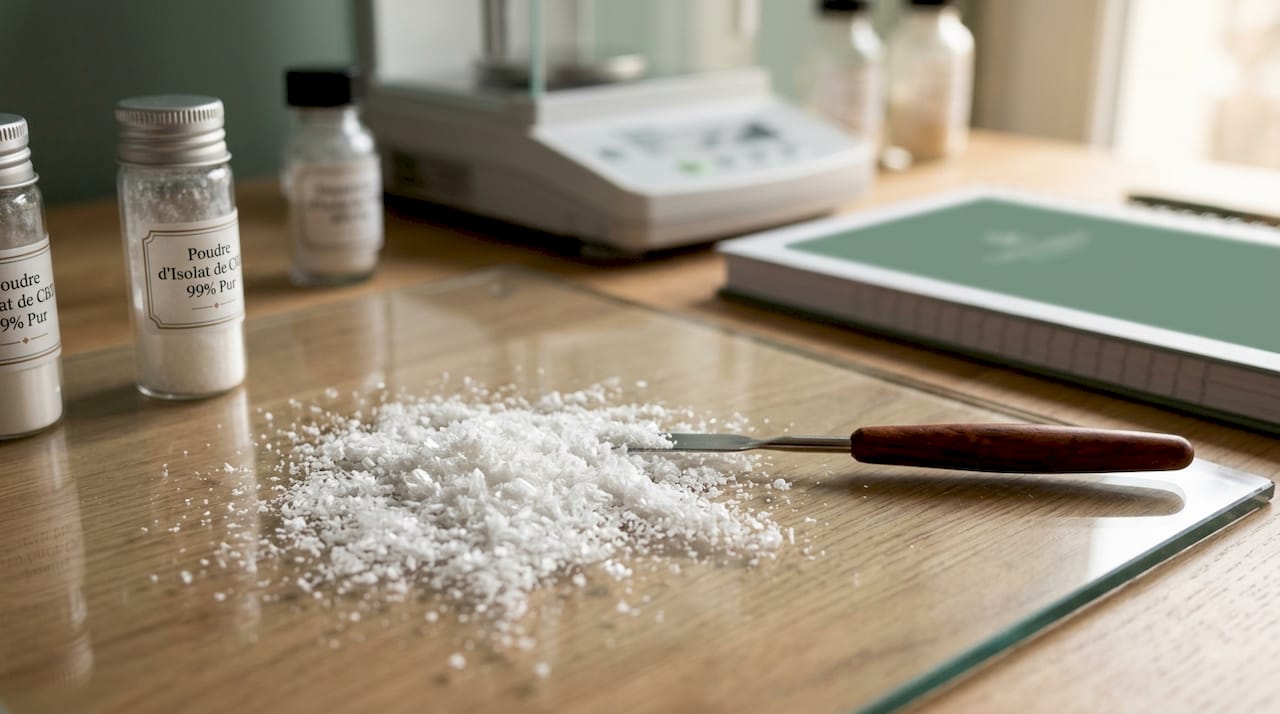
CBD isolate is defined as a cannabidiol extract purified to over 99%, free of THC, terpenes, and any other hemp compounds. Obtained as a white crystalline powder, it is the most concentrated form of cannabidiol available on the market. Unlike full-spectrum or broad-spectrum extracts, the isolate contains no trace of the other molecules found in the plant. For anyone seeking a definition of CBD isolation, it is precisely this process of completely separating cannabidiol from its plant matrix that produces this extremely pure product.
What is CBD isolation, and how is it achieved?
CBD isolation refers to the industrial and scientific process used to separate cannabidiol from all the other compounds present in the hemp plant (Cannabis sativa). The technical term used in the scientific literature is “CBD isolate” or “CBD isolate,” and professionals in the industry use these terms interchangeably. Understanding this process helps explain why the isolate differs so clearly from other extracts.
The complete extraction and purification protocol follows several precise steps:
- Thermal decarboxylation: the plant material is heated to convert CBDA into active CBD, making the cannabidiol available for extraction.
- Supercritical CO2 extraction: this preferred method enables selective extraction of CBD while limiting undesirable components such as solvent residues and heavy metals.
- Winterization: the crude extract is mixed with cold ethanol to precipitate and remove waxes, lipids, and chlorophylls.
- Filtration and chromatography: chromatographic filters separate CBD from the other residual cannabinoids, particularly THC, CBG, and CBN.
- Crystallization: the purified CBD undergoes a crystallization process that produces the characteristic crystals or white powder of the isolate.
This optimized process achieves an overall yield of 52%, with a purity exceeding 99% and negligible THC content. This figure illustrates current industrial efficiency: more than half of the CBD present in the plant ends up in the final product, with no compromise on purity.
Pro tip: When purchasing CBD isolate, always request the certificate of analysis (COA) issued by an independent laboratory. This document confirms the batch’s actual purity and the absence of detectable THC.
Isolate, full spectrum, or broad spectrum: what are the differences?
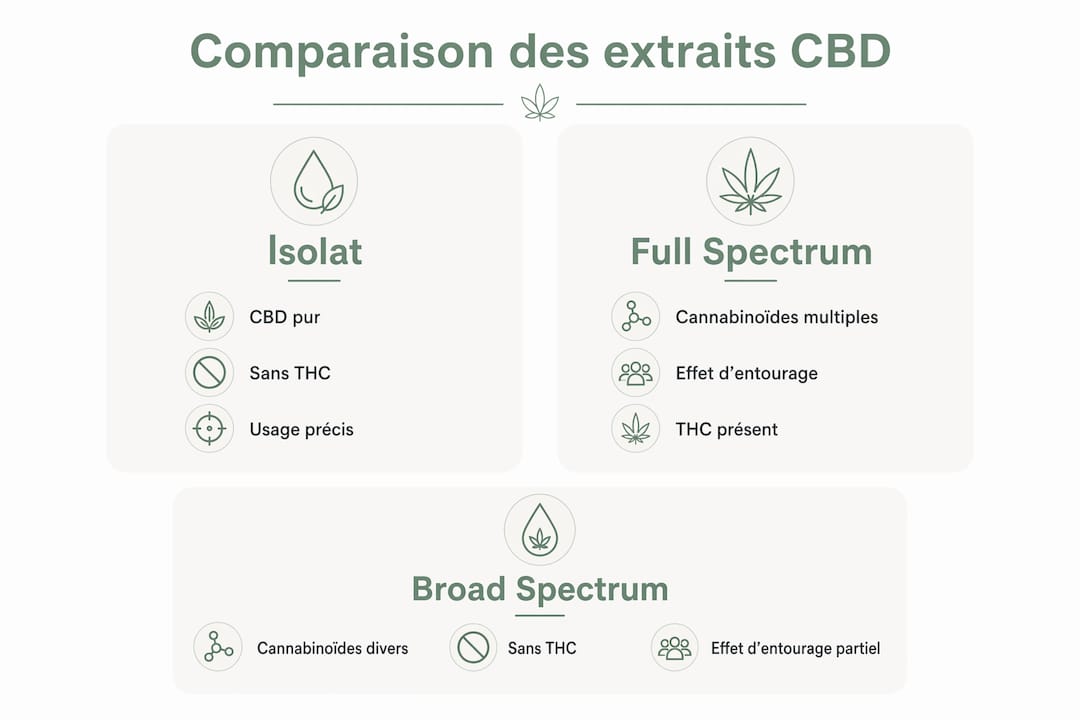
The comparison between the three main forms of CBD extracts is one of the questions consumers ask most frequently. Each form meets different needs, and the choice depends on the user’s profile, goals, and constraints.
| Form | Composition | THC | Entourage effect | Recommended use |
|---|---|---|---|---|
| CBD isolate | Pure CBD at +99% | Absent | No | Precise dosing, zero THC required |
| Broad spectrum | CBD + cannabinoids + terpenes | Absent | Partial | THC sensitivity, synergistic effects |
| Full spectrum | CBD + all compounds | Traces (<0.3%) | Complete | Maximum effectiveness, adult use |
The absence of terpenes and THC in the isolate makes it neutral in sensory terms and predictable in its effects, but it does not benefit from the molecular synergies that researchers call the “entourage effect.” This effect, specific to full spectrum, refers to the enhancement of CBD’s properties through the simultaneous presence of other cannabinoids and terpenes. The absence of this effect in the isolate means, in practical terms, that higher doses may be necessary to achieve comparable results.
Here are the key points to guide your choice:
- Isolate: ideal if you are subject to workplace drug tests, sensitive to THC, or want to precisely control your cannabidiol intake.
- Broad spectrum: a relevant compromise for benefiting from some of the synergies without exposure to THC.
- Full spectrum: recommended for those seeking maximum effectiveness and without THC-related constraints.
Isolate is often preferred by people who want to avoid any risk of testing positive for THC while maintaining a precise, controllable dose. This predictability is a genuine advantage in a medical or professional context.
What are the practical uses of CBD isolate?
CBD isolate stands out for its versatility. Its physical form—fine powder or odorless, tasteless white crystals—makes it easy to incorporate into many products. The most common wellness applications include stress management, improving sleep quality, and supporting physical recovery.
The main ways to use the isolate are as follows:
- Infused oils: the isolate is dissolved in a vegetable oil (hemp, MCT, or olive) to create a CBD oil without THC or unwanted flavor.
- Vaping: the crystals can be vaporized directly or mixed with e-cigarette liquids, providing rapid absorption.
- Topical use: incorporated into cosmetic creams, balms, or serums, the isolate targets specific areas without a systemic effect.
- Sublingual use: the powder can be placed under the tongue for direct absorption into the bloodstream.
- Dietary use (limited and regulated use): some users incorporate it into culinary preparations, although this use is legally restricted in 2026.
One often underestimated aspect concerns dosage. Because the isolate does not benefit from the synergies of other cannabinoids, the effective dose may be higher than that of a full-spectrum extract for an equivalent perceived effect. This does not diminish its value, but it does call for a gradual and attentive approach when establishing a routine.
Quality and batch control remain crucial. A high-quality isolate must be produced from pesticide-free hemp, extracted using certified methods, and analyzed by an independent laboratory. To explore the selection criteria in greater depth, the resource on the purity and safety of CBD-certified isolates offers a practical guide.
Pro tip: Start with a low dose (5 to 10 mg of CBD per serving) and gradually increase it over two weeks. Since isolate is highly concentrated, a gradual approach helps identify your optimal dose without waste.
What is the legal framework for CBD isolate in France in 2026?
The legal status of CBD isolate in France is based on a fundamental distinction: CBD is not classified as a narcotic, because it has no psychoactive effect, unlike THC. This legal distinction allows it to be marketed, subject to compliance with strict conditions depending on the product category.
In 2026, French and European regulations impose the following rules:
- Foodstuffs and supplements: marketing is prohibited for CBD extracts not authorized under the Novel Food Regulation. EFSA has confirmed gaps in the safety data, which prevents authorization to market them as food products.
- Hemp seeds and leaves: seeds and their derivatives, as well as leaves for infusion, are not covered by Novel Food regulations and may be legally sold.
- Cosmetics: the use of isolate in cosmetics remains permitted, subject to compliance with European regulations on cosmetic products.
- Vaping: CBD-containing e-cigarette liquids are permitted within a regulated framework, with traceability and labeling requirements.
- THC content: every product must comply with France’s legal limit of 0.3% THC, and isolate, by definition, contains no detectable THC.
The Novel Food framework requires a specific safety assessment for foods and supplements, and the simple THC level is not sufficient to validate the legality of a CBD-based food product. Controls have been tightened in 2026, with withdrawals of illegal products reported by the French authorities. Consumers should exercise caution: always check the category of the product purchased and its regulatory compliance. Cbd-certified’s guide to legal CBD in France details these nuances for each type of product.
Key points
CBD isolate is the purest form of cannabidiol available, obtained through a rigorous extraction and purification process that removes all THC, terpenes, and other cannabinoids.
| Point | Details |
|---|---|
| Definition of isolate | Purified cannabidiol extract exceeding 99%, without THC or terpenes, in the form of a white crystalline powder. |
| Extraction process | Supercritical CO2 extraction, winterization, chromatography, and crystallization to achieve purity above 99%. |
| Comparison with full spectrum | Isolate does not provide an entourage effect and may require higher doses for comparable effects. |
| Practical uses | Oils, vaping, cosmetics, and sublingual use; gradual dosing is recommended to identify the effective dose. |
| 2026 legal framework | Prohibited in food and supplements without Novel Food authorization; permitted in cosmetics and vaping under certain conditions. |
My analysis of CBD isolate in 2026
After closely following the evolution of the CBD market in Europe, I consider isolate to occupy a distinct, often misunderstood position. Its purity is not a marketing argument: it is a chemical reality that meets specific needs. For an athlete subject to anti-doping tests, a professional working in a sensitive environment, or someone seeking to incorporate CBD into a homemade cosmetic formulation, isolate is the only genuinely safe choice.
What I observe, however, is a tendency to overestimate purity as a universal criterion of effectiveness. Isolate is not superior to full spectrum in terms of perceived effects. It is different. Users who expect immediate results from low doses are often disappointed, not because the product is poor, but because the absence of the entourage effect changes the dynamics of cannabidiol's action.
The regulatory challenge in 2026 is real. Tighter controls on food products and supplements are creating uncertainty for consumers. My recommendation is simple: purchase only from suppliers that publish their certificates of analysis and clearly specify the regulatory category of their products. Transparency is the only reliable indicator of credibility in this market.
The future of isolate will likely involve precision medical and cosmetic applications, where its purity becomes a decisive advantage. Research is advancing, and formulations combining isolate with specific excipients are opening up interesting prospects for the years ahead.
— Rod
Find certified, high-quality CBD isolate
Cbd-certified offers a selection of CBD isolates tested by independent laboratories, with certificates of analysis available for each batch. Each product comes from hemp grown according to strict European standards, ensuring purity that complies with current regulatory requirements. Whether you are looking for an isolate for personal, cosmetic, or vaping use, the range available at the CBD shop in Europe of Cbd-certified covers the main needs, with expert advice included. Deliveries are available throughout the European Union, the United Kingdom, and Switzerland.
FAQ
What exactly is CBD isolate?
CBD isolate is a cannabidiol extract purified to more than 99%, obtained after the complete extraction and purification of the hemp plant. It comes in the form of a white crystalline powder, with no THC, terpenes, or other cannabinoids.
What is the difference between isolate and full spectrum?
The isolate contains only pure CBD, whereas full-spectrum products include all the cannabinoids, terpenes, and traces of THC present in the plant. Full-spectrum products benefit from the entourage effect, which may make them more effective at an equivalent dose.
Is CBD isolate legal in France in 2026?
CBD isolate is legal in France for cosmetic and vaping uses, but its use in food products and supplements remains prohibited without Novel Food authorization. CBD is not classified as a narcotic, which permits its sale in compliant categories.
Why might the isolate require higher doses?
Without the entourage effect provided by terpenes and other cannabinoids, the isolate acts independently on endocannabinoid receptors. Larger doses may sometimes be necessary to achieve effects comparable to those of a full-spectrum or broad-spectrum extract.
How can you check the quality of a CBD isolate?
Request the certificate of analysis (COA) issued by an accredited independent laboratory. This document must confirm a CBD purity above 99%, undetectable THC levels, and the absence of contaminants such as pesticides or heavy metals.