
Understanding CBD Isolate: Purity, Safety, and Uses
TL;DR:
- CBD isolate is the purest form, available as crystals or powder, with no THC or other cannabinoids. It offers precise dosing, no taste, and ensures legality in Europe, particularly for those subject to drug tests. However, the entourage effect of full-spectrum products may be more effective for chronic pain and severe anxiety.
Not all CBD products are created equal, and this confusion often leads European consumers toward choices that are poorly suited to their situation. CBD isolate differs radically from other forms: it is a crystalline powder composed of more than 99% pure cannabidiol, with no trace of THC or other cannabinoids. For those facing professional drug tests, strict regulations, or simply seeking precise dosage control to manage chronic pain, insomnia, or anxiety, isolate represents a serious option. This guide explores its mechanisms, real benefits, limitations, and how to use it knowledgeably.
Table of contents
- Definition and production of CBD isolate
- Mechanism of action and clinical benefits
- Isolate vs. full-spectrum comparison: nuances and choices
- Legality, safety, and side effects of CBD isolate in Europe
- Why isolate is not always suitable: what most people do not know
- Finding a reliable source of isolate or CBD products in Europe
- Frequently asked questions about CBD isolate
Key Points
| Point | Details |
|---|---|
| Maximum purity | CBD isolate guarantees 99% purity and zero THC for safe use. |
| Legal safety in Europe | THC-free CBD isolate complies with European thresholds and avoids any risk during drug tests. |
| Variable effectiveness | For pain, anxiety, or sleep, full-spectrum products may offer greater effects thanks to the entourage effect. |
| Rare side effects | Side effects are generally mild (fatigue, dry mouth) with isolate. |
| Contextual choice | Isolate suits purity or testing requirements, while full-spectrum products offer optimal synergy. |
Definition and production of CBD isolate
Now let’s look at its composition and production to understand where the isolate’s purity comes from.
CBD isolate is the purest form of cannabidiol available on the market. It comes as white crystals or a fine, colorless powder, without any odor and, above all, without a pronounced flavor. This lack of taste is appreciated by those who want to incorporate CBD into preparations without altering their flavor profile.
Unlike full-spectrum CBD or broad-spectrum CBD, isolate contains no other cannabinoids, no terpenes, and no trace of THC. This fundamental distinction makes it the preferred choice for people subject to anti-doping tests or living in countries with stricter legislation.
The manufacture of the isolate follows a rigorous, multistep process:
- Supercritical CO2 extraction: Raw hemp undergoes high-pressure CO2 extraction, making it possible to isolate cannabinoids without unwanted chemical residues.
- Winterization: The extract is mixed with cold ethanol to remove waxes, lipids, and chlorophylls.
- C18 reverse-phase filtration: This step removes the remaining impurities and refines the extract’s chemical profile.
- Silica chromatography: Additional purification separates CBD from other residual compounds.
- Selective crystallization: Pure CBD solidifies and forms the characteristic white crystals of the isolate.
This manufacturing process involves initial supercritical CO2 extraction of decarboxylated hemp, followed by winterization, C18 reverse-phase filtration, silica chromatography, and selective crystallization, with an overall yield of approximately 52% and purity above 99%.
Key takeaway: The purity of the isolate is not a vague marketing claim. It is the direct result of a series of precise, measured processes that can be certified by independent laboratories.
This manufacturing rigor ensures that the final product is consistent from one batch to another, which considerably facilitates dosage control. For someone seeking to manage painful episodes or difficult nights with a precise dose of CBD, this consistency is a major advantage.
Mechanism of action and clinical benefits
After examining the manufacturing process and purity, let’s look at how the isolate interacts with the body and its actual effects.
CBD, whether in isolate form or incorporated into other products, acts on the human endocannabinoid system. This system regulates many biological functions: stress response, pain perception, sleep cycle, and overall mood. CBD isolate interacts with this network without producing psychoactive effects because it contains no THC.
The receptors targeted by CBD mainly include:
- 5-HT1A: A serotonin receptor involved in managing anxiety and mood. Activation of this receptor contributes to a calming effect without excessive sedation.
- TRPV1: A receptor linked to pain perception and inflammation. Its activation by CBD may alleviate chronic pain signals.
- CB1 and CB2 receptors: CBD indirectly modulates these receptors of the endocannabinoid system, influencing the inflammatory response and muscle recovery.
The available empirical data show encouraging results. For anxiety, mixed studies report a 25% to 50% improvement in symptoms, depending on the individual. For sleep, an initial reduction in anxiety helps improve sleep quality in 65% of users in some studies. For pain, a reduction of approximately 30% is observed, although the synergy of the full spectrum remains superior in more complex cases.
These figures deserve some qualification. Individual profiles vary considerably depending on metabolism, symptom severity, and consistency of use. Reviewing the documented benefits of CBD can help set realistic expectations.
Pro tip: Start with a low dose, between 10 and 20 mg per day, and observe your response over two full weeks before increasing it. Note your symptoms in a simple journal: sleep quality, anxiety level, perceived pain. This structured approach will help you identify your optimal dose without waste or disappointment. The uses of CBD in 2026 show that most users who progress gradually achieve better long-term results.
An often underestimated advantage of isolate: the complete absence of psychoactive effects. Even at high doses, it causes neither cognitive impairment, nor a feeling of intoxication, nor paradoxical anxiety. This makes it particularly suitable for people who work, drive, or manage significant daily responsibilities.
Isolate vs. full-spectrum comparison: nuances and choices
For more information, let’s compare isolate and full spectrum to help you make an informed choice.
Choosing between CBD isolate and a full-spectrum product depends above all on your personal situation. Both forms have real advantages, but in different contexts.
Advantages of isolate:
- Guaranteed zero THC, eliminating any risk during drug testing
- Precise, reproducible dosing from one batch to another
- Free of taste and odor, easy to incorporate into homemade preparations
- Legal compliance ensured throughout Europe and beyond
- Ideal for people sensitive to other cannabinoids or terpenes
Advantages of full spectrum:
- Presence of multiple cannabinoids (CBG, CBN, CBC) that act synergistically
- Natural terpenes potentially enhancing effectiveness (entourage effect)
- Potentially superior results for complex chronic pain
- Richer aromatic profile for users who appreciate this aspect
| Criterion | CBD isolate | Full spectrum |
|---|---|---|
| THC content | 0% | Up to 0.3% |
| Entourage effect | Absent | Present |
| Dosage | Highly precise | Varies by batch |
| Taste | Neutral | Earthy, pronounced |
| Legality in Europe | Maximum | Compliant below the threshold |
| Drug testing | No risk | Possible marginal risk |
| Ideal for | Control, precision, safety | Complex symptoms |
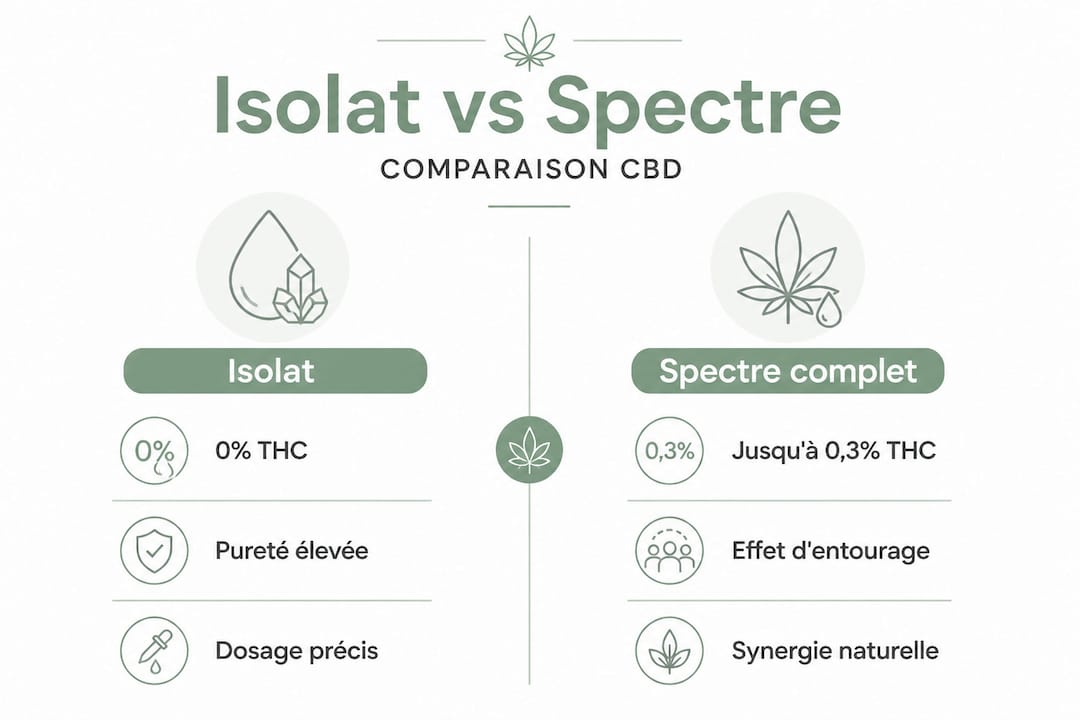
Isolate is suitable for European consumers who are sensitive to THC or subject to drug testing, offering precise dosing without any taste. However, for chronic pain, severe anxiety, or persistent insomnia, full-spectrum or broad-spectrum products may offer greater effectiveness thanks to the entourage effect, although research remains mixed on this point.
Pro tip: If you are hesitating between the two forms, consider your professional situation and legal framework above all. If you undergo regular drug tests, isolate is the obvious choice. As for the benefits of CBD flowers or full-spectrum oils, reserve them for situations where your exposure to THC is not a concern.
To better understand how CBD oils work in each case, the details on how CBD oils work make it possible to compare the mechanisms of action according to the chosen form.
Legality, safety, and side effects of CBD isolate in Europe
It is crucial to understand the legal framework, permitted uses, and side effects in order to use the isolate safely.
In Europe, non-medical CBD is legal provided that the THC content remains below 0.3% under the European threshold. CBD isolate, with 0% THC, is well below this limit, making it one of the safest forms from a regulatory standpoint throughout the European Union, the United Kingdom, and Switzerland.
To fully understand the legal nuances in your country, the page on legal CBD in France offers a detailed overview. Questions about the legal THC threshold are also well covered in the guide on legal THC in Europe.
The most common uses of CBD isolate include:
- Vaping: The isolate can be incorporated into vaporizer liquids, offering rapid absorption through the lungs.
- Ingestion: Dissolved in a carrier oil (coconut oil, MCT), it is taken sublingually or added to food preparations.
- Cosmetics: Incorporated into creams, balms, or serums, the isolate is used for its local anti-inflammatory properties on the skin.
- Capsules: Encapsulated in a precise dose, this is the most convenient format for a daily routine.
| Use | Absorption method | Onset time | Duration of effect |
|---|---|---|---|
| Vaping | Pulmonary | 5 to 15 minutes | 1 to 3 hours |
| Sublingual (oil) | Mucous membranes | 15 to 45 minutes | 4 to 6 hours |
| Ingestion (capsules) | Digestive | 45 to 90 minutes | 6 to 8 hours |
| Cosmetics | Topical | Variable | Variable |
Side effects of CBD isolate are rare and generally mild. The most frequently reported include:
- Dry mouth: A temporary sensation, alleviated by drinking more water.
- Mild fatigue: Especially at higher doses, often perceived as a desired effect in the context of insomnia.
- Possible drug interactions: CBD may influence the metabolism of certain medications through the liver’s CYP450 enzymes. Medical advice is essential if you take regular medication.
There are no documented cases of serious CBD isolate overdose in healthy adults. Therapeutic doses studied in clinical settings range from 25 mg to 300 mg per day depending on the indication, but for general wellness use, doses between 20 and 60 mg are sufficient in the vast majority of cases.
Why isolate is not always suitable: what most people do not know
There is a deeply rooted idea among many consumers: the purer a product is, the more effective it is. This understandable logic does not always apply to CBD.
Isolate is an excellent form for safety, consistency, and control. But chemical purity does not mean maximum therapeutic effectiveness. Cannabis contains more than 100 different cannabinoids, and their combined action produces what researchers call the entourage effect. This effect suggests that hemp molecules work better together than in isolation, much like a team performs better than its individual members working separately.
For people managing mild anxiety or occasional sleep difficulties, isolate may be entirely sufficient. But for severe chronic pain, diagnosed anxiety disorders, or deep insomnia linked to complex causes, the therapeutic use of CBD regularly shows that full-spectrum or broad-spectrum products achieve better results.
The choice should therefore not be reduced to a question of purity, but rather one of context. Someone subject to professional anti-doping tests has no sensible option other than isolate. Someone living in an environment without legal restrictions and seeking to relieve chronic joint pain for years would probably benefit from exploring a broader spectrum.
There is also the question of tolerance. Some users develop a tolerance to isolate more quickly than to full-spectrum products, leading them to increase their doses without proportional results. In these cases, alternating or switching to broad-spectrum products often helps stabilize results. Research on CBD and anxiety confirms that individual variability is one of the most decisive factors in treatment response.
The real advice here: do not rely solely on purity as a selection criterion. Assess your situation, constraints, and goals before choosing the CBD form that best suits you.
Finding a reliable source of isolate or CBD products in Europe
You now have a clear understanding of what CBD isolate is, how it works, and when it is the best choice. The next step is to source it from reputable suppliers capable of guaranteeing the purity, legal compliance, and traceability of their products.
European CBD Shop offers a carefully selected range of certified CBD isolates and products, with certificates of analysis (COAs) available for each batch. Whether you are looking for pure isolate for a specific use or full-spectrum oils for a more comprehensive approach, the shop delivers throughout the European Union, the United Kingdom, and Switzerland. Each product complies with the European legal THC limit and is manufactured according to strict quality standards. Taking care of yourself starts with choosing products you can truly rely on, with clear information and transparent traceability. Visit cbd-certified.com to explore options suited to your specific needs.
Frequently asked questions about CBD isolate
Can CBD isolate cause a positive result on a THC screening test?
No. Since it contains 0% THC, CBD isolate does not produce a positive result on standard screening tests.
What are the most common side effects of CBD isolate?
Side effects are rare but may include slight dry mouth and temporary fatigue, generally associated with high doses.
Is CBD isolate less effective than full-spectrum CBD for chronic pain?
For complex pain, full-spectrum synergy is generally superior thanks to the entourage effect, while isolate remains effective for less severe cases or when the absence of THC is essential.
How can you recognize authentic CBD isolate?
Authentic CBD isolate comes in the form of white powder or crystals, with an independent certificate of analysis (COA) confirming a CBD purity of over 99% and 0% THC.