
Differences between EU and UK CBD: 2026 guide
TL;DR:
- The EU regulatory framework for CBD requires prior authorization with a minimum purity of 98%, whereas in the United Kingdom, the FSA list allows transitional sales based on commercial evidence. THC thresholds in the hemp plant differ, at 0.3% in the EU and 0.2% in the United Kingdom, but limits for finished products are often stricter. Compliance depends primarily on regulatory status, purity, and verification through a certificate of analysis, rather than on the advertised CBD content.
CBD marketed in the European Union and the United Kingdom is governed by two distinct regulatory frameworks, with authorities, safety thresholds, and authorization procedures that differ in concrete ways. In the EU, the EFSA (European Food Safety Authority) oversees the assessment of novel foods under the Novel Food Regulation. In the United Kingdom, the FSA (Food Standards Agency) manages a public list of validated products. Understanding these differences between EU and UK CBD is not merely a matter of legal curiosity: it determines whether the product you buy is legal, safe, and compliant with the standards in force.
What are the regulatory frameworks for CBD in the EU and the UK?
CBD intended for human consumption is subject to the Novel Food Regulation in both regions, but the implementation methods differ radically. In the EU, Regulation (EU) 2015/2283 requires prior authorization granted after a full assessment by the EFSA. No food product containing CBD may be placed on the market without this approval. This rule applies to all Member States, including France, Germany, and the Netherlands.
In the United Kingdom, the FSA also applies the Novel Food regime, but with a different mechanism. Manufacturers that marketed their products before February 13, 2020, may appear on a public list of validated products and continue selling during the review period. Products absent from this list must be removed from the market. This system creates a transitional window that the EU does not provide.
Purity requirements are also more explicit on the European side. The EFSA requires a minimum purity of 98% for CBD isolates submitted for evaluation, with no nanoparticles and a complete dossier on the manufacturing process. The UK FSA relies more on commercial documentary evidence, such as invoices or purchase orders dated before the key date in 2020.
Both systems protect certain sensitive populations, but EFSA formalizes this more explicitly. The provisional safe dose set by EFSA is 0.0275 mg per kg of body weight per day, or approximately 2 mg for a 70 kg person. This limit does not apply to people under 25, pregnant women, or breastfeeding women. This point remains largely unknown to consumers.
- EU: prior authorization mandatory, EFSA assessment, purity ≥ 98%, no sale without an approved dossier.
- United Kingdom: FSA list with a transitional period, commercial evidence required, mandatory withdrawal of unlisted products.
- At-risk populations: explicitly excluded from EFSA recommendations; the FSA issues similar but less regulatory binding warnings.
Pro tip: Before buying a CBD food supplement in France or another EU country, check whether the product has an active Novel Food authorization. Without this indication, the product cannot legally be marketed under the regulations currently in force.
How do THC thresholds differ between the EU and the United Kingdom?
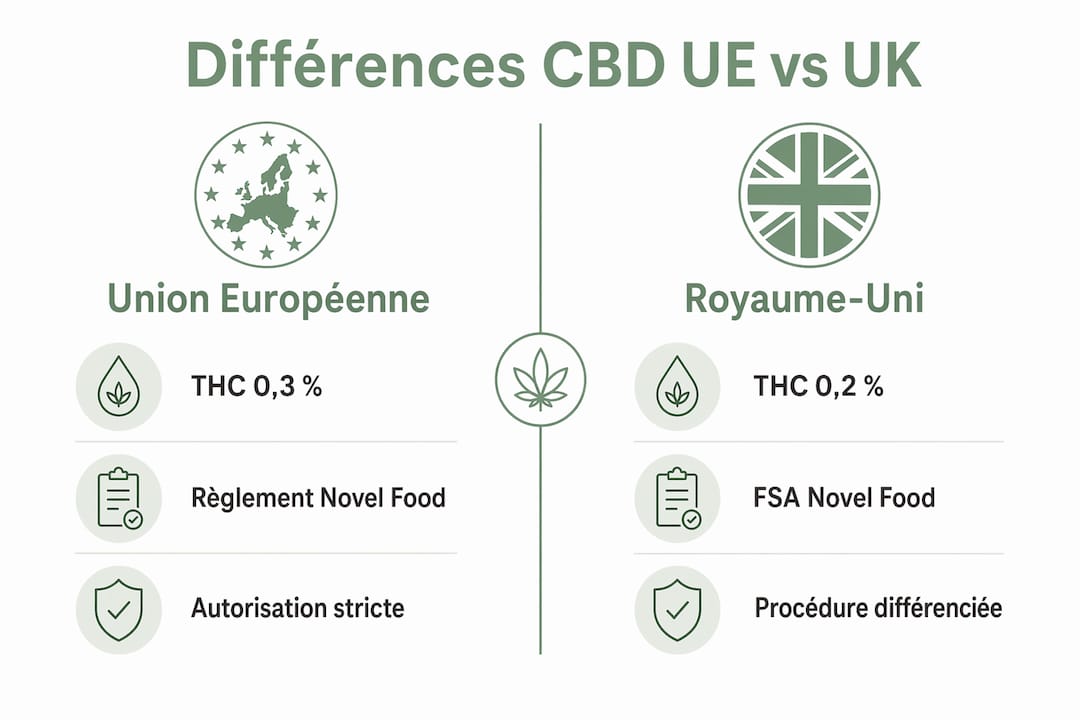
The THC threshold for cultivated hemp plants is set at 0.3% in the EU, but this limit concerns agricultural cultivation, not finished products. For foodstuffs containing CBD, the applicable thresholds are much lower and vary according to the product form. This distinction is often overlooked by consumers who focus solely on the CBD content displayed on the label.
In the United Kingdom, the FSA applies stricter analytical criteria to certain products. CBD isolates may be subject to a THC limit as low as 0.01%, measured by high-performance liquid chromatography (HPLC). This requirement exceeds what is commonly applied in EU member states to the same product categories.
| Criterion | EU | United Kingdom |
|---|---|---|
| THC in the hemp plant | 0.3% maximum | 0.2% maximum |
| THC in CBD isolates | Not harmonized between Member States | 0.01% (FSA criterion, HPLC method) |
| Reference analytical method | Varies by country | Standardized HPLC |
| Safe daily dose (CBD) | 0.0275 mg/kg/day (EFSA) | Not uniformly established |
| Excluded populations | Under 25, pregnant/breastfeeding women | Pregnant women, children |
The toxicological risks associated with exceeding these thresholds are documented. EFSA uses the concept of an ARfD (acute reference dose) to assess the effects of a single high exposure to THC. A poorly controlled CBD product may contain enough traces of THC to cause adverse effects in sensitive consumers, even without any psychoactive intent.
Pro tip: Choose products accompanied by a certificate of analysis (COA) issued by an independent third-party laboratory. This document must state the CBD and THC levels measured by HPLC, not just the values declared by the manufacturer. To learn more about legality in the United Kingdom, see the dedicated guide.
What are the differences in authorization procedures and market access?
The Novel Food authorization procedure in the EU is lengthy, centralized, and non-negotiable. Here are the concrete steps a manufacturer must follow to market an edible CBD product in the European Union:
- Preparation of the dossier: the manufacturer submits a complete dossier to the European Commission, including toxicological data, stability studies, the manufacturing process, and evidence of purity (≥ 98% for isolates).
- EFSA assessment: the European Food Safety Authority analyzes the dossier, issues a scientific opinion, and identifies any gaps. This process can take several years.
- Commission decision: based on the EFSA opinion, the European Commission grants or refuses authorization. Without a favorable decision, the product cannot be sold.
- National enforcement: each Member State applies the decision. In France, ANSES and the DGCCRF oversee the market and may order recalls.
In the United Kingdom, the FSA procedure works differently. Manufacturers with evidence of commercial activity dating from before February 2020 (invoices, delivery notes, screenshots of online sales) may appear on the public FSA list and continue selling while their application is under review. This mechanism creates a grace period that does not exist in the EU. In practice, this means that a British consumer can legally buy a product that is still under assessment, whereas a French consumer cannot.
Product withdrawals clearly illustrate this difference. In France, CBD food supplements were removed from store shelves in 2026 due to the lack of a valid Novel Food authorisation. In the United Kingdom, similar products remain available as long as they appear on the FSA list, even if their application has not yet been definitively approved. For consumers, this means a wider choice across the Channel, but greater regulatory uncertainty regarding the products’ final approval.
Which CBD products are permitted or prohibited in the EU and the United Kingdom?
The product category determines its legal status just as much as its composition. The rules differ depending on whether it is a food, a supplement, a cosmetic or an e-liquid.
- CBD food supplements in the EU: not authorised for sale in France and most Member States, due to the lack of an approved Novel Food authorisation. Products still on store shelves are in violation.
- CBD food supplements in the United Kingdom: permitted under certain conditions, provided that the product appears on the FSA list and that the application is under review or approved.
- CBD cosmetics: permitted in the EU, including France, because they do not fall under the Novel Food Regulation. CBD used in topical applications is not considered a food.
- CBD flowers and resins: their legal status varies considerably. In France, the sale of CBD flowers is legally regulated but remains sensitive. In the United Kingdom, CBD flowers are in a regulatory grey area, as they may be treated as controlled cannabis depending on their THC content.
- CBD e-liquids: subject to regulations on tobacco and nicotine products in both regions, with additional restrictions depending on the country.
To avoid buying a non-compliant product, here are the checks to carry out before any purchase:
- Check whether the product appears on the public FSA list (for purchases in the United Kingdom).
- Request the certificate of analysis (COA) with the CBD and THC levels measured in a laboratory.
- Check that the manufacturer explicitly states the product’s Novel Food status.
- Avoid products without clear labeling about the origin of the hemp and the extraction process.
To compare the available forms of CBD and their legal implications, Cbd-certified’s oil vs. flowers guide offers a detailed overview by product category.
Key points
A CBD product’s compliance depends less on its stated cannabidiol content than on its regulatory status, analytical purity, and the region in which it is marketed.
| Point | Details |
|---|---|
| EU regulatory framework | The EFSA requires prior Novel Food authorization; no sales are permitted without an approved application. |
| UK regulatory framework | The FSA maintains a list of validated products with a transitional period for applications in progress. |
| THC thresholds | The UK applies 0.01% to CBD isolates, a stricter threshold than the EU standard. |
| Authorized products | Cosmetics are permitted in the EU; food supplements remain prohibited without authorization. |
| Key quality criterion | Purity (≥ 98%) and the absence of nanoparticles take precedence over the raw CBD percentage. |
What I learned by closely following these regulations
Many consumers think that a CBD product is reliable if it displays a high cannabidiol content and a reasonable price. This is a misreading of the market. Regulatory compliance stems from product purity, the absence of contaminants, and the strength of the dossier submitted to the authorities—not from the figure printed on the label.
What strikes me about the EU versus UK comparison is that the British system is easier for informed consumers to understand. The FSA list is public, searchable, and allows you to check within seconds whether a product is under review. In the EU, the absence of an equivalent list makes verification more opaque. A product may be withdrawn from the market without the consumer having received the slightest prior warning.
I also think that regulatory developments from 2026 to 2027 will further accentuate these differences. The EU is gradually tightening its Novel Food requirements, which will further reduce the number of legally available food CBD products in member states. In the UK, the FSA is moving toward final approvals, which should clarify the situation for manufacturers and consumers. Staying informed about legal updates is not optional if you consume CBD regularly.
— Rod
Where to buy CBD that complies with EU and UK regulations?
Choosing a certified supplier is the best protection against non-compliant products. A good CBD shop should display its products’ certificates of analysis, state the regulatory status of each item, and deliver to areas where sales are legally regulated.
Cbd-certified meets these criteria for European and British consumers. The store offers a selection of verified products, with delivery available in the EU, the United Kingdom, and Switzerland. To find the best CBD shops in Europe that comply with current standards, Cbd-certified brings together the market’s most reliable options. Consumers based in Scotland or England can also consult the dedicated selection of CBD shops in Edinburgh for validated local options.
FAQ
Is CBD legal in France in 2026?
CBD food supplements are not authorized for sale in France because they lack a Novel Food authorization approved by EFSA. CBD-based cosmetics remain legal because they do not fall under the Novel Food Regulation.
What is the THC limit for CBD products in the United Kingdom?
The UK FSA applies a THC limit as low as 0.01% for CBD isolates, measured using HPLC. This threshold is stricter than the standards generally applied in EU member states to the same products.
How can you check whether a CBD product complies with UK regulations?
Consult the FSA’s public list to check whether the product appears among applications under review or approved applications. Also request the product’s certificate of analysis (COA) to confirm the actual CBD and THC levels.
Who can safely consume CBD according to EFSA?
EFSA excludes people under 25, pregnant women, and breastfeeding women from its recommendations. For at-risk populations, specific precautions are detailed in Cbd-certified’s CBD safety guide.
Are CBD flowers permitted in the EU and the United Kingdom?
The status of CBD flowers varies by EU country and remains a gray area in the United Kingdom, where they may be treated as controlled cannabis depending on their THC content. Local regulations should be checked before any purchase.