
Step-by-step guide to sleep with CBD
In brief:
- Cannabidiol (CBD) is a non-psychoactive compound from hemp that regulates sleep, anxiety and recovery. Its effectiveness depends on regular use, choosing the right form, personalized dosing and a consistent nighttime routine. Product quality, sleep tracking and adherence to basic principles maximize its effects to help you sleep better.
Cannabidiol (CBD) is defined as a non-psychoactive compound from hemp that acts on the endocannabinoid system to regulate sleep, anxiety and recovery. This step-by-step guide to sleeping with CBD gives you a clear, validated and gradual protocol for incorporating cannabidiol into your nighttime routine safely. Each step is based on concrete principles: choosing the right form, calibrating the dosage, respecting the timing and building a consistent routine. CBD does not appeal like a chemical sleeping pill. Its effectiveness depends on consistency and method.
What are the prerequisites for using CBD properly to sleep?
Three forms of CBD dominate the European sleep market: sublingual oil, capsules and infusions. Each meets a different need depending on whether the main problem is falling asleep or nighttime awakenings.

Sublingual oils act quickly within 20–30 minutes, making them ideal for difficulty falling asleep. Capsules and infusions act more slowly, between 30 and 90 minutes, but their effects last 6–8 hours. This extended profile is better suited to people who wake up in the middle of the night.
| Form | Onset time | Duration of effects | Optimal use |
|---|---|---|---|
| Sublingual oil | 15–45 min | 4–6 hours | Difficulty falling asleep |
| Capsules | 30–90 min | 6–8 hours | Frequent nighttime awakenings |
| CBD infusion | 30–60 min | 5–7 hours | Gradual relaxation before bedtime |
For administration, a graduated dropper is essential with oil. Capsules require no special equipment. A glass of lukewarm water is enough for infusions. The environment matters just as much as the product: a quiet room, dim lighting and a cool temperature (between 17 and 19 °C) prepare the body to receive the effects of CBD.
Pro tip: Choose only products accompanied by a certificate of analysis (COA) issued by an independent laboratory. This document guarantees the actual CBD concentration and the absence of contaminants.
How do you determine the optimal CBD dosage for sleep?
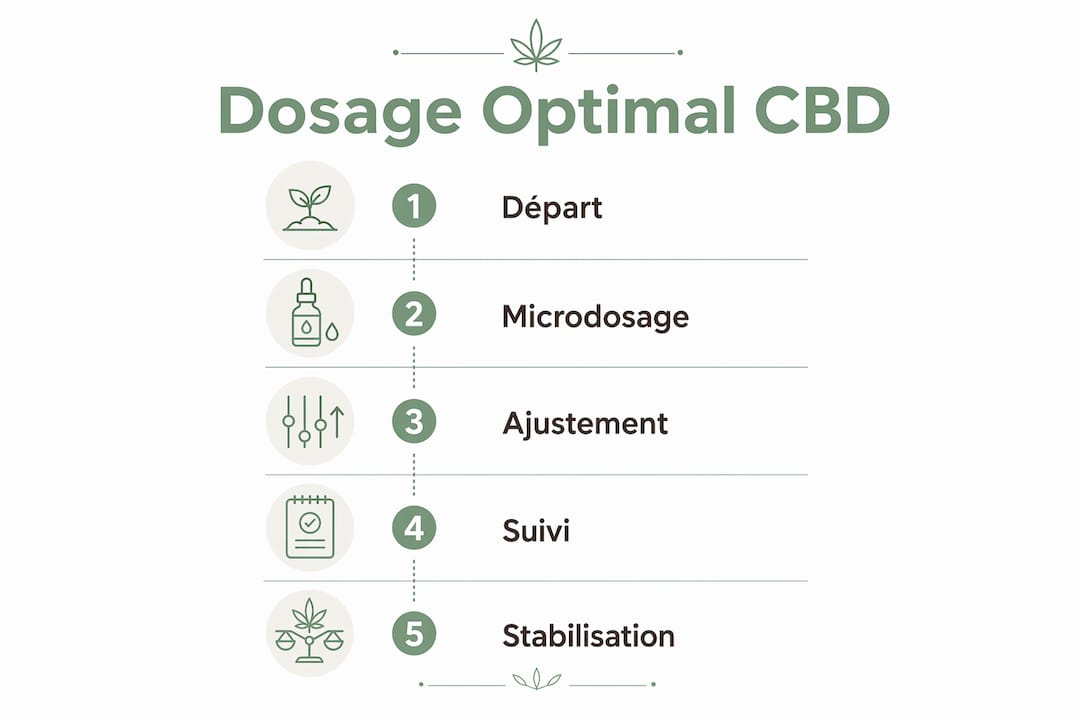
The recommended starting dosage is between 10 and 20 mg of CBD per dose. This low range limits side effects while allowing you to observe the body's response. Increasing too quickly is the most common mistake.
A gradual microdosing over 3–7 nights before adjusting the dose balances the endocannabinoid system without causing daytime drowsiness. This slow progression is the key to a sustainable protocol.
| Profile | Approximate weight | Starting dose | Maximum recommended dose |
|---|---|---|---|
| Light / moderate anxiety | Under 60 kg | 10 mg | 25 mg |
| Moderate / mild insomnia | 60–80 kg | 15 mg | 35 mg |
| Heavy / severe insomnia | Over 80 kg | 20 mg | 50 mg |
The impact of CBD varies according to each person's weight, metabolism, and level of anxiety. A dosage that is effective for one person may be insufficient or excessive for another. This individual variability justifies a personalized approach rather than a universal dose.
Common mistakes to avoid:
- Increasing the dose after a single night without visible results
- Taking a high dose right away to “speed up” the effects
- Changing the form and dosage of CBD at the same time
- Forgetting to record the effects observed each morning
Pro tip: Keep a sleep journal during the first 4–6 weeks. Note the time of intake, the dose, your perceived sleep quality, and nighttime awakenings. This sleep tracking is the most effective strategy for precisely adjusting the treatment without overdosing.
What are the precise steps for administering CBD before bedtime?
The administration protocol varies according to the form chosen. Here are the detailed steps for each method.
Sublingual oil
- Measure the dose using the provided graduated dropper. Count the drops or read the volume in milliliters according to the concentration of your oil.
- Place the oil under the tongue, directly onto the sublingual mucous membranes. Avoid placing it on top of the tongue.
- Keep the oil in place for 60–90 seconds without swallowing. This duration is essential for sublingual absorption and prevents premature breakdown by the digestive system.
- Swallow the remainder after this time. Do not drink or eat for at least 15 minutes after taking it.
- Take the oil 30–60 minutes before bedtime so that the effect is fully active when you fall asleep.
Capsules and infusions
- Swallow the capsule with a large glass of water, 60–90 minutes before bedtime. The longer onset time requires taking it in advance.
- For the infusion, pour water at 80 °C over the CBD and let it steep for 5–8 minutes. Drink slowly, without added sugar, which could disrupt nighttime blood sugar levels.
- Avoid a heavy meal during the hour before taking it. An overly full stomach slows absorption and delays the effects.
For nighttime awakenings, a double dose of CBD is more effective than one large dose. Take a first dose in the evening, then a reduced dose (5–10 mg of oil) if you wake up after 2 a.m. or 3 a.m.
Pro tip: Keep your oil bottle on the bedside table for possible nighttime use. Immediate access means you do not have to get fully out of bed and further disrupt your sleep.
How can you incorporate CBD into an effective nighttime routine?
CBD acts as a sleep regulator, not a sedative. Its effectiveness depends directly on the quality of the environment in which it is taken. Combining CBD with a healthy lifestyle is essential to firmly establish the sleep reflex over the long term.
An effective nighttime routine is based on these pillars:
- Turn off screens 60 minutes before bedtime. Blue light blocks melatonin and counteracts CBD's effects.
- Gradually dim the lights during the 90 minutes before bedtime to signal to your biological clock that night is approaching.
- Synchronize CBD intake with your circadian rhythm by always taking it at the same time. Consistency strengthens the effect.
- Add a relaxation technique: abdominal breathing, 10-minute guided meditation, or reading a physical book. These practices enhance CBD's calming effect.
- Avoid caffeine after 2:00 p.m. and alcohol in the evening. Alcohol fragments sleep cycles and cancels out the benefits of cannabidiol.
A screen-free routine with soft lighting and gentle music enhances CBD’s effects before bedtime. A soothing environment helps reinforce the sleep reflex in synergy with cannabidiol.
A standard protocol lasts 4–6 weeks with rigorous monitoring to gradually adjust the dose and form. This duration allows the endocannabinoid system to adapt and produce stable effects. To explore other complementary approaches, non-alcoholic drinks for sleep are an interesting alternative to incorporate into your routine.
Pro tip: Set the same bedtime every evening, including weekends. Consistency in timing is the most underestimated factor in the effectiveness of a CBD regimen.
How can you manage common difficulties and mistakes with CBD for sleep?
Regular CBD use makes it easier to fall asleep after several days of consistent use, not immediately. Expecting results from the first night leads to abandoning too soon a protocol that would have worked with patience.
| Common mistake | Observable sign | Solution |
|---|---|---|
| Dose too high from the outset | Daytime drowsiness, heavy-headed feeling | Reduce by 5 mg and stabilize for 5 nights |
| Irregular use | Inconsistent effects that are difficult to assess | Set a fixed time every evening |
| Wrong form chosen | Effect is too short-lived or takes too long to appear | Switch to capsules if you wake up during the night |
| Lack of monitoring | Unable to adjust the dosage | Keep a sleep diary |
CBD can interact with certain medications. Blood thinners and sedatives are the two categories most affected. If you are currently undergoing treatment, consult your doctor before starting a course of CBD.
Some signs that warrant a medical consultation:
- No effect at all after 3 weeks at an appropriate dose
- Onset of persistent headaches or nausea
- Worsening anxiety or nighttime awakenings
- Simultaneous use of prescription medications
CBD does not replace medical treatment but is a complementary tool for regulating sleep. This distinction is fundamental to avoid delaying necessary medical care.
Key points
CBD durably improves sleep when taken at a gradually increasing dose, at a fixed time, in a form suited to the main issue, and combined with a consistent nighttime routine.
| Point | Details |
|---|---|
| Choose the right form | Oil for falling asleep, capsules or infusions for nighttime awakenings. |
| Start with a low dose | Start with 10 to 20 mg and increase only after 3–7 stable nights. |
| Respect the timing | Take the oil 30–60 minutes before bedtime for a synchronized effect. |
| Build a routine | Combine CBD with avoiding screens, dim lighting, and a fixed bedtime. |
| Track and adjust | Keep a sleep diary for 4–6 weeks to precisely calibrate the dose. |
What I learned by observing hundreds of CBD protocols
The biggest mistake I see time and again is impatience. People who give up on CBD after three or four nights without spectacular results are missing out on something real. Cannabidiol does not work like a sleeping pill. It gradually recalibrates a nervous system that has often taken months, or even years, to become dysregulated.
What surprised me most was the importance of the form chosen. Many people take capsules to fall asleep faster, even though sublingual oil is clearly better suited to this specific need. Conversely, those who suffer from repeated nighttime awakenings achieve much better results with capsules or a combination of both. It is not a question of product quality, but of matching the form to the problem.
I also want to emphasize the importance of consulting a doctor for anyone taking medication. This is not a token precaution. Interactions with blood thinners or anti-anxiety medications are documented and deserve serious attention. To learn more about CBD and medication interactions, reliable resources are available.
Finally, CBD alone is not enough. The people who achieve the best results are those who have also improved their sleep hygiene: a fixed bedtime, no screens, and a cool bedroom. CBD amplifies a good routine. It does not replace it.
— Rod
Certified CBD products for better sleep
Choosing a quality CBD product is just as important as following the right protocol. Cbd-certified offers a selection of oils and capsules specifically formulated to support nighttime wellness, with certificates of analysis available for each product.
The broad-spectrum CBN + CBD oil from Cbd-certified combines two complementary cannabinoids for a relaxation effect targeted at sleep. For an even more complete formulation, the THC-free CBN + CBG + CBD oil Nobilis offers a broader spectrum suited to persistent insomnia. Cbd-certified delivers in France, throughout the European Union, the United Kingdom, and Switzerland. The complete range is available directly online, with detailed product descriptions to help you choose with confidence.
Frequently Asked Questions
When should you take CBD to fall asleep faster?
Take sublingual oil 30–60 minutes before bedtime. Capsules require 60–90 minutes in advance because they take longer to absorb.
What CBD dosage should you start with for insomnia?
The recommended starting dose is 10–20 mg per night. Increase by only 5 mg after 3–7 stable nights at the same dose.
Can CBD interact with my medications?
Yes. CBD interacts in particular with blood thinners and sedatives. Consult your doctor before starting a course if you are currently taking medication.
How long does it take to see the effects of CBD on sleep?
Stable effects generally appear after several days of regular use. A complete protocol lasts 4–6 weeks for lasting results.
Can you take CBD twice a night?
Yes, taking a double dose is recommended for frequent nighttime awakenings. Take a reduced dose of 5–10 mg if you wake up in the middle of the night, rather than one strong dose in the evening.