
Why choose natural CBD for your well-being
TL;DR:
- Choosing natural CBD guarantees purity in line with organic standards, with supercritical CO2 extraction and independent testing. European regulations impose strict THC thresholds and require a certificate of analysis (CoA) to ensure safety and compliance in 2026. Choose transparent brands from organic cultivation for safe and effective use suited to your needs.
Natural CBD is an extract of hemp grown without pesticides or chemicals, certified through responsible extraction methods and independent laboratory analyses that guarantee purity and compliance. Choosing natural CBD over an industrial or synthetic product is above all a public health decision. In Europe, the CBD market is growing rapidly, but not all products are equal. Organic quality in CBD rests on three concrete pillars: cultivation traceability, the extraction method, and transparency in certificates of analysis. This article guides you through each criterion so you can make an informed choice.
Why choose natural CBD: essential quality criteria
High-quality natural CBD can be identified by four specific characteristics, all of which can be verified before purchase.
- Grown without pesticides or herbicides: hemp is a bioaccumulator plant. It absorbs substances present in the soil, including heavy metals and chemical residues. Hemp grown using certified organic farming guarantees the absence of these contaminants in the final product.
- Supercritical CO2 extraction: this method preserves all cannabinoids and terpenes without leaving solvent residues. Supercritical CO2 extraction guarantees a full spectrum of beneficial molecules, unlike harsh chemical extractions based on hexane or industrial ethanol.
- Certificates of Analysis (CoA): every reputable natural CBD product comes with a certificate of analysis issued by an independent third-party laboratory. This document confirms the CBD level, THC level, absence of contaminants, and the product’s overall purity.
- Complete traceability: the hemp’s origin, country of cultivation, batch number, and processing conditions must be accessible. The transparency of information is the key trust factor for European consumers in 2026.
- Contaminant testing: analyses must cover heavy metals, mycotoxins, pesticide residues, and residual solvents. A product without these checks cannot be described as natural or safe.
Pro tip: Always request the certificate of analysis (CoA) before buying. If a brand does not provide it spontaneously, that is a warning sign. Reputable brands publish these documents directly on their website or send them upon request.
What is the difference between natural and synthetic CBD?
Natural and synthetic CBD share the same molecular formula, but their efficacy and safety profiles differ significantly.
| Criterion | Natural CBD (full spectrum) | Synthetic CBD or industrial isolate |
|---|---|---|
| Origin | Organically grown hemp | Chemical synthesis in a laboratory |
| Composition | Cannabinoids + terpenes + flavonoids | CBD alone, without natural cofactors |
| Entourage effect | Present, molecular synergy | Absent or limited |
| Residual risks | Low with CO2 extraction | Possible solvent residues |
| Traceability | Complete, verifiable | Often opaque |
| Regulatory compliance | Generally easier to certify | Varies depending on the process |
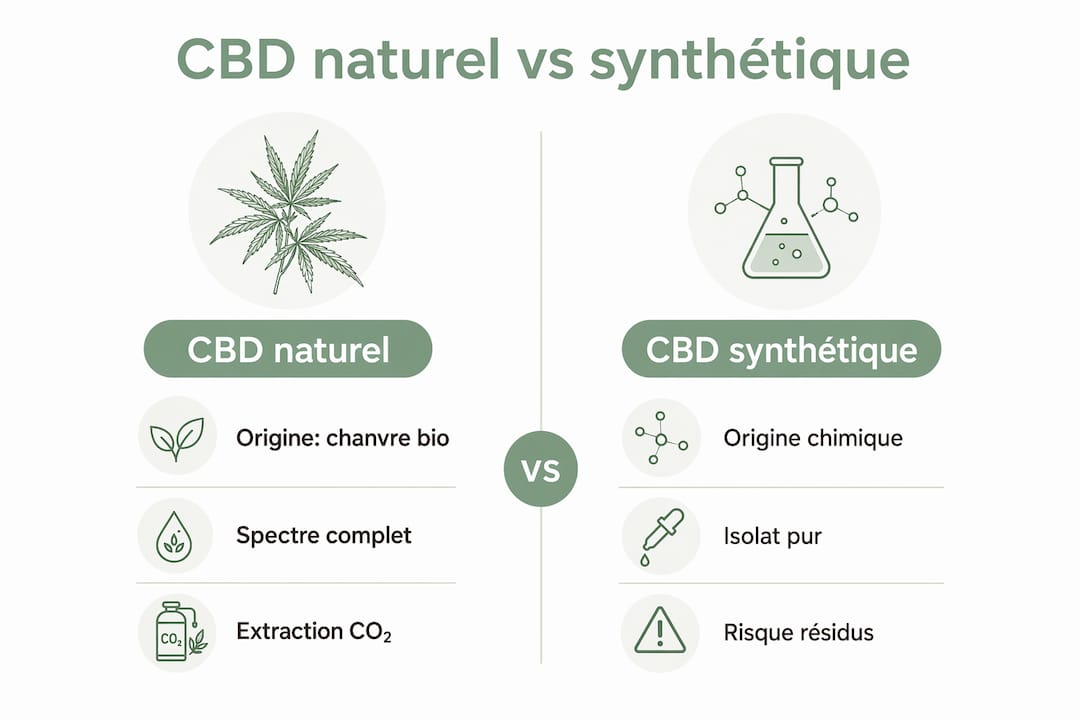
The difference between natural and synthetic CBD lies primarily in the presence or absence of complementary cannabinoids and terpenes that enhance the therapeutic effect. This phenomenon, known as the entourage effect, explains why natural full-spectrum CBD often produces more noticeable results than a 99% pure isolate.
Industrial or synthetic products present an additional risk: chemical residues resulting from aggressive extraction processes. These residues are not always detected by basic analyses, and their accumulation in the body remains poorly documented. The EFSA itself warns about the toxicological gaps surrounding CBD, particularly regarding effects on the liver, endocrine system, and nervous system. This uncertainty is more relevant to poorly controlled products than to certified natural CBD.
Bioavailability is also better with natural full-spectrum CBD. Terpenes facilitate the absorption of cannabinoids at the cellular level, meaning that a lower dose can produce an effect equivalent to that of a higher dose of synthetic isolate.
What are the European regulations for CBD in 2026?
The European legal framework for natural CBD rests on two main pillars: the Novel Food regulation for ingested products and separate regulations for vaping products.
For food products, the situation has changed significantly. In France, CBD food products such as oils, herbal teas, and candies have been prohibited since May 2026 without Novel Food authorization. Only CBD vaping products remain authorized without this specific authorization procedure. This distinction is fundamental for any consumer or buyer in Europe.
Regarding THC content, the rule is clear: less than 0.3% THC is required for a CBD product to be legal in France and most European countries. Above this threshold, the product is subject to severe restrictions. The certificate of analysis is the only document that can prove this compliance.
The EFSA has set a provisional safe intake level for food-grade CBD at 0.0275 mg/kg/day, or approximately 2 mg per day for a 70 kg adult, solely for a pure isolate containing at least 98% CBD and no nanoparticles. This figure illustrates the caution of European health authorities toward a market still under evaluation. It is not evidence that CBD is ineffective, but rather a call for rigor when selecting products.
The European legal framework is stricter for ingestible products than for vaping, creating a significant regulatory asymmetry. Consumers who purchase CBD oil must now check that the product has an active or granted Novel Food authorization, otherwise they risk buying a technically non-compliant product.
Pro tip: Always check whether the CBD product you are buying has active Novel Food status or a national exemption. This information should appear on the packaging or the manufacturer's website. If in doubt, contact the brand directly.
How do you choose a natural CBD product suited to your needs?
Choosing an effective natural CBD product requires a methodical approach. Here are the steps to follow to select a product suited to your health and well-being profile.
-
Identify your main need. Natural CBD is used for three major categories of needs: managing stress and anxiety, improving sleep, and relieving mild to moderate pain. Each need points to a different type of product and dosage.
-
Check the origin of the hemp. Choose products made from hemp grown in Europe, particularly in Switzerland, Austria, or France, where agricultural standards are high. The designation “certified organic hemp” or an AB (Organic Agriculture) label is a reliable indicator.
-
Check the extraction method. Supercritical CO2 extraction is the benchmark. It produces a clean extract, free of solvent residues, while preserving the complete profile of cannabinoids and terpenes. Avoid products whose extraction method is not disclosed.
-
Read the certificate of analysis. The CoA should indicate the exact CBD content, the THC content (below 0.3%), and the absence of heavy metals, pesticides, and residual solvents. A practical guide to recognizing quality CBD will help you interpret these documents correctly.
-
Adjust the dosage gradually. Start with a low dose, observe the effects over 7 to 14 days, then adjust. The optimal dosage varies according to weight, metabolism, and individual sensitivity. A step-by-step guide to choosing your CBD product can support you through this process.
-
Prefer transparent brands. A serious brand publishes its CoAs online, states where its hemp comes from, details its extraction method, and answers consumers’ questions. Transparency is not a bonus; it is the minimum.
Drivers should pay particular attention: regular consumption of full-spectrum CBD can lead to an accumulation of THC metabolites detectable in saliva tests. This risk remains low with compliant products but should be taken into account.
Key points
Certified natural CBD is the only coherent choice for anyone wishing to combine well-being, health safety, and regulatory compliance in Europe in 2026.
| Point | Details |
|---|---|
| Quality criteria | Check for organic cultivation, supercritical CO2 extraction, and a certificate of analysis before making any purchase. |
| Natural vs. synthetic difference | Natural full-spectrum CBD offers an entourage effect that industrial isolates lack. |
| 2026 regulatory framework | CBD food products without Novel Food authorization have been banned in France since May 2026. |
| Legal THC level | The maximum legal threshold is 0.3% THC, proven only by a certificate of analysis. |
| Appropriate choice | Identify your needs, verify traceability, and gradually adjust the dosage over two weeks. |
My view on natural CBD in Europe: safety first
After years of observing the European CBD market, I am convinced that most consumers underestimate one fundamental point: choosing natural CBD is not an aesthetic or marketing preference. It is a risk-reduction decision.
Regulations are changing quickly, sometimes faster than brands can adapt. The ban on CBD food products in France in May 2026 is direct proof. Products legally sold 18 months ago are now non-compliant. A consumer who has not checked the Novel Food status of their CBD oil may unknowingly be buying an illegal product.
What I consistently recommend: trust only brands that publish their CoAs without you having to ask for them. Proactive transparency is the only reliable indicator of seriousness. Uncontrolled products do not deserve your trust, regardless of their marketing claims.
— Rod
Where to buy certified natural CBD in Europe?
Cbd-certified offers a carefully selected range of natural CBD products, all accompanied by independent certificates of analysis and compliant with current European regulations. Each product is traceable from hemp cultivation through to final packaging.
Deliveries cover the European Union, the United Kingdom, and Switzerland. Whether you are looking for full-spectrum CBD oil, flowers, or vaping products, Cbd-certified selects only products made from organic hemp using supercritical CO2 extraction. Browse the full selection of the best CBD shops in Europe to find the product suited to your needs, with complete confidence.
FAQ
What exactly is natural CBD?
Natural CBD is a cannabidiol extract obtained from hemp grown without pesticides, extracted using gentle methods such as supercritical CO2, and certified through independent laboratory analyses guaranteeing purity and regulatory compliance.
Is natural CBD legal in France in 2026?
Yes, provided that the product contains less than 0.3% THC and, for ingested products, has Novel Food authorization. CBD vaping products remain authorized without this specific procedure.
What is the safe CBD dose according to the EFSA?
The EFSA sets a provisional safe dose of 0.0275 mg/kg/day for a pure isolate of at least 98%, or approximately 2 mg per day for a 70 kg adult. This value applies only to food products and reflects the authorities’ caution in light of still-incomplete toxicological data.
How can you verify that CBD is truly natural?
Ask for the product’s certificate of analysis (CoA). This document must confirm the CBD content, THC content below 0.3%, and the absence of pesticides, heavy metals, and residual solvents. The lack of an accessible CoA is an immediate warning sign.
Is full-spectrum CBD better than an isolate?
Natural full-spectrum CBD contains complementary terpenes and cannabinoids that enhance the effect through molecular synergy, often called the entourage effect. A synthetic isolate does not benefit from this effect, which may require higher doses for a comparable result.