
CBD and irritable bowel syndrome: relieving pain
In brief:
- Cannabidiol is known to reduce pain and inflammation associated with irritable bowel syndrome. It acts primarily through the endocannabinoid system, modulating visceral hypersensitivity and strengthening the intestinal barrier. Its effectiveness is generally observed between 10 and 21 days, as a complement to overall management of the disorder.
Cannabidiol (CBD) is known for its analgesic and anti-inflammatory properties, making it a serious option for managing pain associated with irritable bowel syndrome (IBS). This functional disorder affects between 5% and 10% of the Western population, with prevalence reaching 15% according to some studies. IBS is characterized by chronic abdominal pain, bloating, and bowel disturbances that profoundly affect quality of life. CBD and irritable bowel syndrome pain are now an active area of research, with encouraging clinical results for people in Europe seeking alternatives to conventional treatments.
How does CBD act on irritable bowel syndrome pain?
CBD acts on IBS pain primarily through the endocannabinoid system, a network of receptors found throughout the gastrointestinal tract. This system regulates intestinal motility, pain sensitivity, and the local inflammatory response. Understanding this mechanism helps explain why CBD produces measurable effects on digestive symptoms.
Modulation of visceral hypersensitivity
Visceral hypersensitivity is the main cause of abdominal pain in IBS. CBD modulates this hypersensitivity via the TRPV1 and CB1 receptors, two key targets of the enteric nervous system. TRPV1 receptors detect heat and pain; CBD progressively desensitizes them. CB1 receptors, present in high concentrations in the intestine, regulate the transmission of pain signals to the brain.
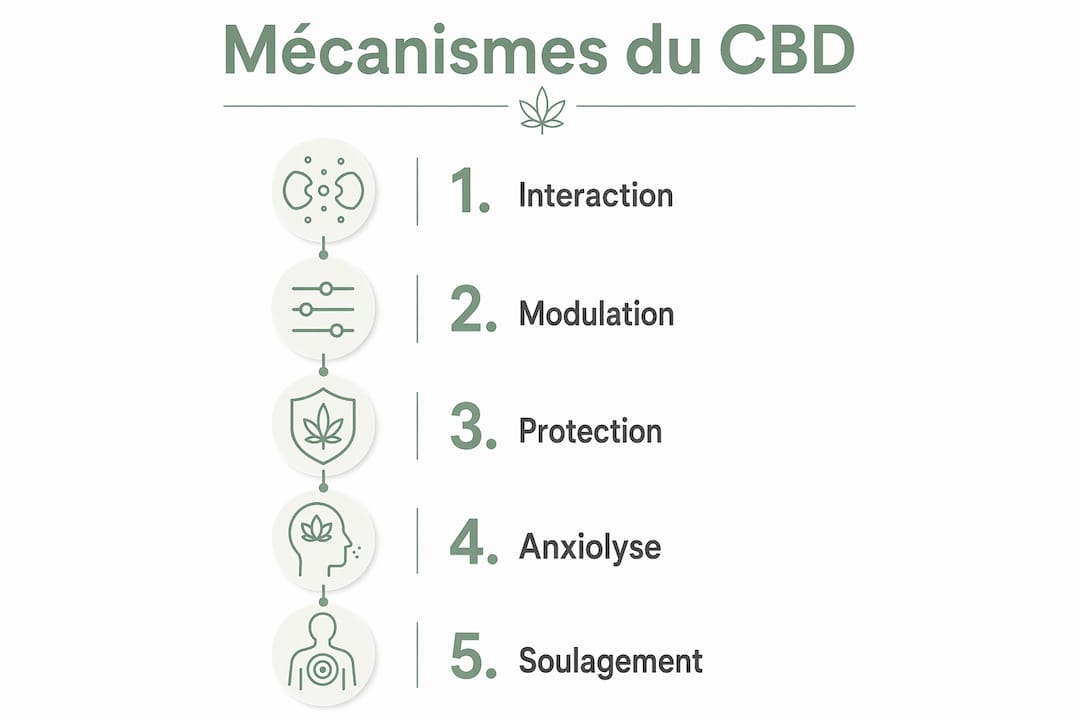
IBS is also associated with a clinical deficiency in endocannabinoids, known by the acronym CEDS (Clinical Endocannabinoid Deficiency Syndrome). Polymorphisms of the CB1 receptor are associated with greater severity of abdominal pain. CBD partially offsets this imbalance by stimulating the endocannabinoid system without causing psychoactive effects.
Protection of the intestinal barrier and anxiolytic effect
CBD strengthens the tight junctions of the intestinal epithelium, thereby reducing excessive intestinal permeability, sometimes referred to as “leaky gut.” A stronger intestinal barrier limits the passage of irritating substances into the bloodstream. This effect has been demonstrated under experimental in vitro conditions.

The gut-brain axis plays a central role in IBS. CBD reduces activity in the amygdala, the brain region linked to anxiety, which indirectly reduces stress-triggered intestinal spasms. To learn more about this mechanism, the article by Cbd-certified on the endocannabinoid system and pain details these interactions.
The main effects of CBD on IBS are:
- Reduction of pain sensitivity via TRPV1 and CB1 receptors
- Reduction of local inflammation in the intestinal mucosa
- Strengthening of the intestinal epithelial barrier
- Reduction of digestive anxiety via 5-HT1A receptors
- Regulation of intestinal motility
Pro tip: CBD acts on pain perception and digestive anxiety, not on an organic lesion. Distinguishing between these two effects is essential for setting realistic expectations from the outset.
What CBD doses and forms can relieve IBS?
CBD dosing for intestinal pain is not universal. Each person responds differently depending on their weight, metabolism, and symptom severity. Gradual progression is the safest and most effective method.
Gradual dosing protocol
- Start with 10–20 mg per day. This initial dose helps assess individual tolerance without risking overload. Effective doses for IBS generally range from 20 to 80 mg per day according to clinical observations.
- Divide the doses. Taking CBD in the morning and evening stabilizes plasma levels and prolongs the analgesic effect throughout the day.
- Increase in increments of 5–10 mg. Wait at least one week before each adjustment to properly assess the response.
- Monitor effects and record symptoms. A daily log helps identify the optimal dose and detect any potential side effects.
Choosing the right form of CBD
The choice of CBD product spectrum directly influences its effectiveness for digestive disorders. The table below summarizes the main differences.
| CBD form | Composition | Advantage for IBS |
|---|---|---|
| Pure isolate | CBD alone | Targeted effect, without other cannabinoids |
| Broad spectrum | CBD + CBG + terpenes, without THC | Better anti-inflammatory synergy |
| Full spectrum | CBD + all cannabinoids, traces of THC | Maximum entourage effect, legality varies |
Broad-spectrum products containing CBG offer particularly interesting synergy for reducing intestinal inflammation. CBG (cannabigerol) has specific anti-inflammatory properties that complement CBD’s action. Pure isolates remain a valid option for people sensitive to other cannabinoids.
To understand the technical differences between these forms, the article by Cbd-certified on CBD isolation provides useful details.
Pro tip: Choose a sublingual oil for rapid absorption and precise dosing. CBD gummies offer a convenient alternative for taking CBD on the go, with a slightly longer onset of action.
What are the benefits and limitations for IBS pain?
CBD improves the quality of life of people with IBS, but its effects vary depending on the individual and the type of symptoms. Setting clear expectations from the outset helps avoid disappointment and encourages sustained use.
The observed benefits include:
- Reduced visceral pain and abdominal cramps
- Reduced digestive anxiety and stress-triggered episodes
- Improved overall intestinal comfort and bowel regularity
- Better quality of sleep, often disrupted by chronic pain
The beneficial effects generally begin within 3 to 7 days for digestive anxiety. A noticeable reduction in visceral pain usually occurs between 10 and 21 days. It is important to communicate this timeframe to prevent prematurely discontinuing treatment.
“CBD is not a miracle cure. It improves quality of life alongside traditional treatments, notably by modulating visceral hypersensitivity and through its anxiolytic effect. Its use should form part of a comprehensive strategy validated with a healthcare professional.”
CBD does not cure IBS. It does not address the disorder's underlying organic causes. Some people do not experience significant improvement, particularly those whose symptoms are mainly related to untreated dietary factors. Interactions with other medications, particularly antispasmodics or antidepressants, warrant special attention. Medical consultation before taking it remains essential, especially for chronically ill patients undergoing treatment.
How to integrate CBD into comprehensive IBS management?
CBD produces its best results when incorporated into a comprehensive approach combining diet, stress management, and conventional treatments. None of these components alone is sufficient to sustainably control IBS symptoms.
Diet and low-FODMAP diet
The low-FODMAP diet (fermentable oligosaccharides, disaccharides, monosaccharides and polyols) is the nutritional standard for IBS. It reduces intestinal fermentation and associated pain. Targeted dietary approaches, particularly identifying individual food intolerances, effectively complement CBD's action on pain.
Stress management and complementary therapies
Stress systematically worsens IBS symptoms through the gut-brain axis. Meditation, cardiac coherence, and cognitive behavioral therapy (CBT) reduce the reactivity of the autonomic nervous system. CBD reinforces this effect by acting directly on anxiety receptors. Cbd-certified's article on CBD and anxiety explains this mechanism in detail.
Complementarity with conventional treatments
CBD should remain complementary to conventional drug treatments for IBS, such as antispasmodics, osmotic laxatives, or probiotics. It does not replace these treatments. However, it may improve their overall effectiveness by reducing the anxiety and pain components.
Key points for successful integration into your daily routine:
- Take CBD at a fixed time, preferably with a light meal to improve absorption
- Continue the appropriate diet alongside it, without interruption
- Inform your doctor about adding CBD to your treatment plan
- Reassess symptoms every three weeks to adjust the dose if necessary
- Avoid alcohol and ultra-processed foods that worsen intestinal permeability
Pro tip: Keep a symptom diary during the first 30 days of CBD use. Record pain on a scale of 10, bowel movement quality, and stress level. This concrete data guides dosage adjustments much better than general impressions.
Key points
CBD relieves IBS pain by modulating visceral hypersensitivity through TRPV1 and CB1 receptors, with measurable effects between 10 and 21 days for pain and 3 to 7 days for digestive anxiety.
| Point | Details |
|---|---|
| Main mechanism | CBD acts on TRPV1 and CB1 receptors to reduce intestinal pain sensitivity. |
| Recommended dosage | Start at 10–20 mg per day and gradually increase up to 80 mg according to tolerance. |
| Best form of CBD | Broad-spectrum extracts with CBG offer the best anti-inflammatory synergy for IBS. |
| Time to effectiveness | Digestive anxiety improves in 3–7 days; visceral pain decreases in 10–21 days. |
| Holistic approach | CBD works best when combined with a low-FODMAP diet and stress management. |
What I learned from advising people with IBS
The question I hear most often is: “Will CBD cure me?” My answer is always the same: no, but it can significantly change your daily life if you use it correctly.
What I regularly observe is that people who give up on CBD after two weeks have not waited long enough. Visceral pain takes time to respond. At least three weeks are needed to honestly evaluate its effect on abdominal cramps. Digestive anxiety responds more quickly, often as early as the first week.
The other common mistake concerns the choice of product. Many people buy a pure isolate because it is cheaper, even though a broad-spectrum product with CBG would have produced much better results for intestinal inflammation. The price per milligram is not the right selection criterion for IBS.
What concerns me more is the lack of dialogue with the doctor. CBD interacts with certain liver enzymes that also metabolize many medications. This interaction is not insignificant. Using CBD without informing your doctor means taking an unnecessary risk when transparency is enough to avoid it.
My deep conviction is that CBD has a genuine role to play in managing IBS, provided it is incorporated with method, patience, and honesty about what it can and cannot do.
— Rod
CBD products suited to intestinal pain
People with IBS need products whose quality and composition can be verified. Cbd-certified offers a selection of laboratory-tested products, with analyses available for each batch.
For intestinal pain, broad-spectrum oils with CBG such as Super Relax CBD & CBG or CBD CBG pain gummies are particularly suitable. Cbd-certified delivers throughout the European Union, the United Kingdom, and Switzerland. The CBD shop in Europe makes it quick to find certified products suited to your needs, with clear guidance on dosage and spectrum.
Frequently asked questions
Is CBD effective against IBS pain?
CBD reduces visceral pain from IBS by modulating TRPV1 and CB1 receptors. Effects on pain generally appear between 10 and 21 days after starting use.
What dose of CBD should you take for irritable bowel syndrome?
The recommended initial dose is 10–20 mg per day, with a gradual increase up to 20–80 mg depending on individual tolerance and the severity of symptoms.
Which form of CBD should you choose for digestive disorders?
Broad-spectrum extracts containing CBG are best suited to IBS. They offer better anti-inflammatory synergy than pure CBD isolates.
Can CBD replace conventional IBS treatments?
No. CBD complements conventional treatments such as antispasmodics or probiotics. Its use should be discussed with a doctor, especially if you are currently undergoing treatment.
How long does it take to feel the effects of CBD on IBS?
Digestive anxiety improves within 3–7 days. A noticeable reduction in abdominal pain occurs between 10 and 21 days, according to clinical observations.