
CBD and the limbic system: function and emotions
In brief:
- Cannabidiol (CBD) influences the limbic system by modulating the endocannabinoid system to regulate emotions. It acts through several mechanisms, including FAAH inhibition and modulation of 5-HT1A and GABA-A receptors, to reduce anxiety and stress. CBD safety requires cautious use, with a recommended dose of approximately 2 mg per day, taking drug interactions into account.
Cannabidiol (CBD) alters the functioning of the limbic system by acting on the endocannabinoid system, directly influencing emotional regulation and mental health. The limbic system is the brain's emotional center: it processes fear, motivation, memory, and stress. CBD, a non-psychoactive molecule extracted from cannabis, interacts with this network through specific brain receptors. Understanding the link between CBD and limbic system function makes it possible to assess its effects on anxiety more rigorously and with less confusion.
How does the limbic system work in regulating emotions?
The limbic system comprises several brain structures that coordinate emotions, memory, and motivation. The three most important structures are the hippocampus, amygdala, and nucleus accumbens. Each plays a distinct but interconnected role in how you feel and respond to the world.
- The hippocampus encodes emotional memories and regulates the response to chronic stress.
- The amygdala detects threats and triggers fear or anxiety responses.
- The nucleus accumbens manages motivation, pleasure, and the reward circuit.
These structures communicate through neurotransmitters such as serotonin and GABA. Serotonin stabilizes mood, while GABA reduces excessive neuronal excitation. An imbalance in these systems causes anxiety, mood disorders, or disproportionate stress responses.
CB1 receptors in the limbic system are particularly dense in the hippocampus and nucleus accumbens. This density explains why the endocannabinoid system plays a central role in emotional regulation. CBD specifically targets these areas, which explains the growing interest in its use for managing stress and anxiety.

Pro tip: If you want to understand why CBD affects people differently, start by looking at individual variability in CB1 receptor density. This density varies genetically and influences sensitivity to CBD’s effects.
What are the mechanisms of action of CBD on the limbic system?
CBD acts on the brain through several simultaneous biological pathways. This multiple-action profile distinguishes it from single-target molecules and explains its remarkable tolerability.
-
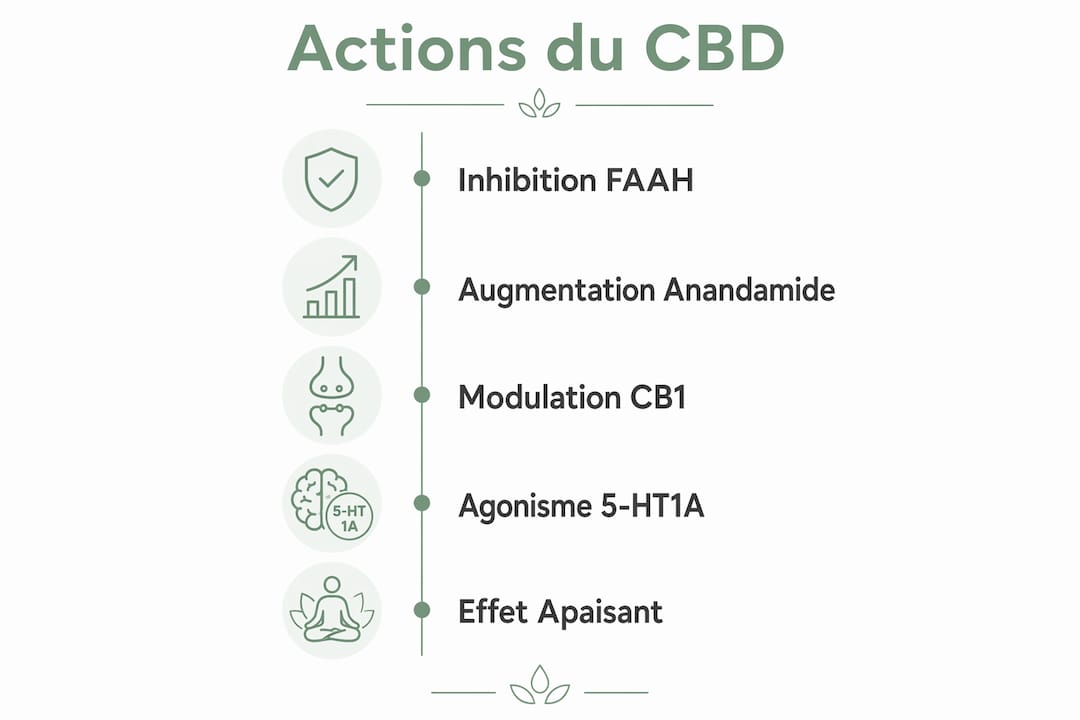
FAAH inhibition and increased anandamide levels. CBD inhibits the FAAH enzyme, which slows the breakdown of anandamide. Anandamide is a natural neurotransmitter of the endocannabinoid system, often called the “bliss molecule.” Its higher concentration amplifies the body’s internal calming signals.
-
Allosteric modulation of CB1 receptors. CBD does not bind directly to CB1 receptors like THC. It modulates them indirectly, which amplifies calming signals without causing psychotropic effects. This distinction is fundamental: CBD enhances the endocannabinoid system without saturating it.
-
Partial agonist action on 5-HT1A receptors. CBD interacts with 5-HT1A receptors for serotonin in the limbic system. This partial action improves anxiety regulation without causing complete emotional numbing. The result is a more balanced emotional response, not a suppression of emotions.
-
GABA-A modulation. The positive modulation of GABA-A by CBD contributes to its anxiolytic and anticonvulsant effects. GABA is the main brake on the central nervous system. Strengthening its activity reduces the neuronal hyperexcitation associated with anxiety.
-
Neuroprotective and antioxidant effects. CBD reduces oxidative stress and neuroinflammation in limbic structures. This action protects neurons over the long term and supports the health of the central nervous system.
| Mechanism | Target | Observed effect |
|---|---|---|
| FAAH inhibition | Anandamide | Increase in calming tone |
| CB1 modulation | Cannabinoid receptors | Amplification of internal signals |
| 5-HT1A agonism | Serotonin | Anxiety reduction |
| GABA-A modulation | Inhibitory neurotransmission | Anxiolytic and anticonvulsant effect |
| Antioxidant action | Limbic neurons | Neuroprotection |
Pro tip: CBD acts as an allosteric modulator of cannabinoid and serotonergic receptors. This means that it adjusts the intensity of existing signals rather than replacing them. It is precisely this mechanism that gives it much greater tolerance than classic anxiolytics.
What impact does CBD have on emotions and mental health?
CBD influences emotions primarily through the limbic system and its connections with serotonergic pathways. The best-documented effects concern anxiety and the stress response.
-
Anxiety reduction. CBD increases serotonergic tone via 5-HT1A receptors, producing an effect similar to that of certain antidepressants but without their characteristic side effects. Available clinical studies show a measurable reduction in situational and chronic anxiety.
-
Stress modulation. CBD influences the hypothalamic-pituitary-adrenal axis, which controls cortisol release. Higher endocannabinoid activity in the hippocampus reduces stress reactivity. The limbic system and CBD thus form a tandem in regulating the emotional response to stress.
-
Memory and motivation. CBD influences the hippocampus and nucleus accumbens, two structures involved in memory consolidation and motivation. This explains why some people report greater mental clarity and reduced rumination after regular use.
-
Comparison with classic anxiolytics. Benzodiazepines also act on GABA, but non-selectively and with a high potential for dependence. CBD, on the other hand, modulates GABA-A more selectively and without documented pharmacological tolerance in the short term.
-
Individual variations. The response to CBD varies according to the density of CB1 receptors, liver metabolism, and each person’s emotional context. These variations explain why some people experience pronounced effects while others experience very little. To explore this topic further, the article on the role of CBD in anxiety explains these mechanisms with concrete examples.
Precautions and limitations: safety, dosage, and side effects
CBD has a favorable safety profile, but its use in relation to the limbic system requires an informed approach. European health authorities have established clear guidance.
-
Prudent daily dose. The EFSA sets a prudent dose of 0.0275 mg/kg per day, or approximately 2 mg for an average-weight adult. This recommendation reflects the lack of data on the long-term neuropsychiatric effects in healthy people.
-
Lack of long-term data. Available studies mainly cover short to medium durations. The effects of prolonged consumption on the limbic system remain insufficiently documented. Caution is warranted, particularly for people undergoing psychiatric treatment.
-
Drug interactions. CBD is metabolized by the liver’s CYP450 enzymes, the same enzymes involved in the metabolism of many medications. Possible drug interactions notably concern anticoagulants, antiepileptic drugs, and certain antidepressants. Prior medical advice is essential if you take regular medication. For an overview of safety, Cbd-certified’s guide for people with chronic conditions offers practical guidance.
-
Rare side effects. The most frequently reported side effects are mild drowsiness, dry mouth, and changes in appetite. These effects remain dose-dependent and are generally reversible upon discontinuation.
-
Tips for responsible use. Start with a low dose and increase gradually. Choose products whose composition can be verified through third-party testing. Avoid self-medicating for severe psychiatric disorders without professional support.
Key takeaway: The EFSA recommends a daily dose of approximately 2 mg for an adult because of a lack of data on the long-term neuropsychiatric effects.
Key points
CBD acts on the limbic system through FAAH inhibition, modulation of CB1 receptors and partial agonism at 5-HT1A receptors, producing emotional balance without psychotropic effects.
| Point | Details |
|---|---|
| Main mechanism | CBD inhibits FAAH and increases anandamide, amplifying the brain's natural calming signals. |
| Limbic targets | The hippocampus, amygdala and nucleus accumbens are rich in CB1 receptors that are sensitive to CBD. |
| Effect on anxiety | CBD modulates serotonin 5-HT1A receptors to reduce anxiety without emotional numbing. |
| Recommended dose | The EFSA sets a prudent dose of approximately 2 mg per day for a healthy adult. |
| Key precaution | Drug interactions via CYP450 enzymes require medical advice before use. |
What CBD science has taught me about the brain
After years of following research on CBD and neurobiology, one thing strikes me: the general public underestimates the sophistication of CBD's mechanism of action, while skeptics overestimate it in the wrong direction. CBD is neither a placebo nor a miracle drug. It is a fine-tuned modulator of a biological system already present in every human brain.
What seems most underestimated to me is the distinction between modulation and activation. CBD does not replace serotonin or GABA. It adjusts the sensitivity of the receptors that receive them. This nuance changes everything: it explains why CBD does not cause pharmacological dependence in the classical sense, and why its effects vary so much from one person to another.
What concerns me more is the lack of robust longitudinal studies on the long-term effects of CBD on the limbic system. Current research is promising but fragmented. Using CBD as daily emotional support without medical supervision is like navigating with an incomplete map.
My advice: approach CBD as a complementary tool, not as a substitute for serious care. The people who benefit most from it are those who integrate it into a comprehensive approach that includes a healthy lifestyle, psychological support and, if necessary, medical treatment. Scientific rigor and an open mind are not incompatible. Both are necessary.
— Rod
Reliable CBD products to support your emotional balance
Understanding how CBD works on the limbic system is a first step. Choosing products whose quality can be verified is another, equally important one.
Cbd-certified selects CBD products that undergo independent third-party testing, guaranteeing purity and exact cannabidiol concentration. Each product is chosen for compliance with European regulations, allowing you to consume with confidence. Whether you are looking to manage daily stress or naturally support your mental health, the certified store in Europe from Cbd-certified offers a range suited to your needs. Deliveries are available throughout the European Union, the United Kingdom, and Switzerland.
Frequently asked questions
How does CBD act on the limbic system?
CBD inhibits the FAAH enzyme, which increases anandamide in limbic structures such as the hippocampus and nucleus accumbens. It also modulates serotonin 5-HT1A receptors and GABA-A, producing a calming effect without psychotropic effects.
Can CBD reduce anxiety in a clinically proven way?
Available studies show that CBD reduces situational and chronic anxiety via 5-HT1A receptors, with a more favorable side-effect profile than traditional anxiolytics. However, long-term data remain limited.
What CBD dose is recommended to affect emotions?
The EFSA recommends a cautious dose of approximately 2 mg per day for an adult due to the lack of data on long-term neuropsychiatric effects. Always start with a low dose and adjust gradually.
Does CBD have psychotropic effects on the limbic system?
No. CBD indirectly modulates CB1 receptors and does not cause psychotropic effects, unlike THC. This distinction is confirmed by studies on the allosteric modulation of cannabinoid receptors.
Does CBD interact with psychiatric medications?
Yes. CBD is metabolized by CYP450 enzymes, which can alter the concentration of certain medications in the blood, particularly antidepressants and antiepileptic drugs. Prior medical advice is essential before combining them.